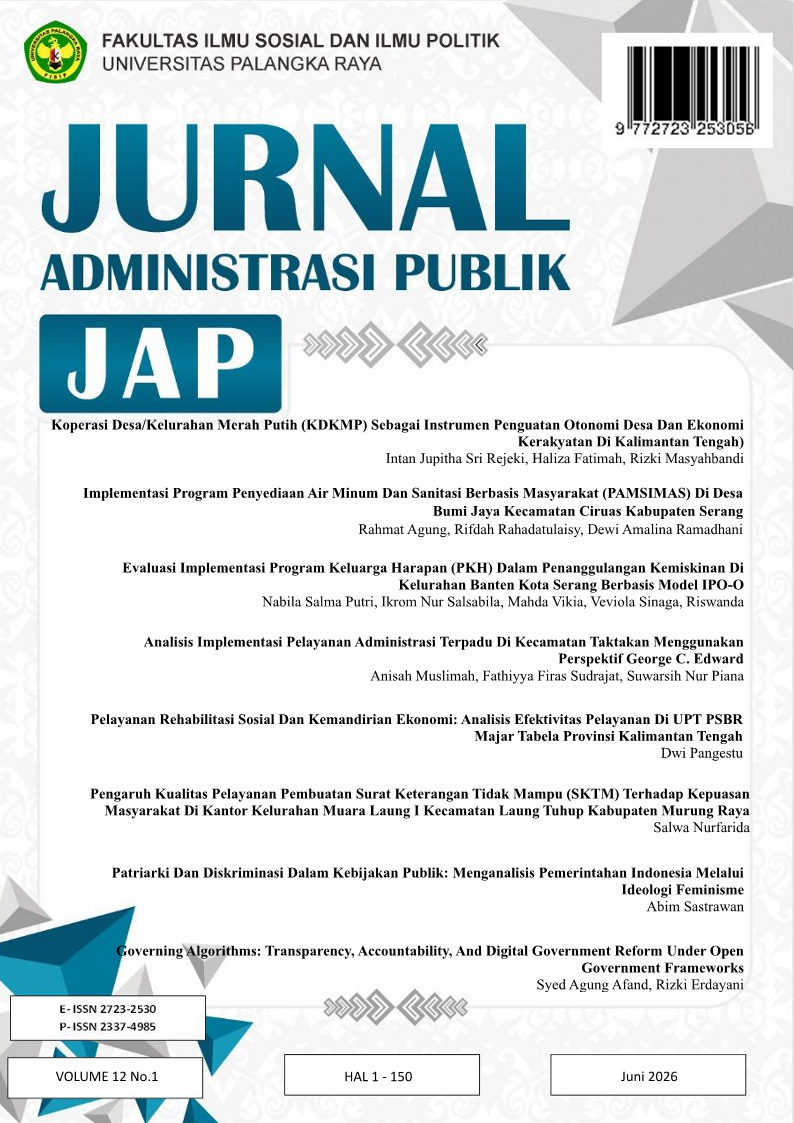
Governing Algorithms: Transparency, Accountability, And Digital Government Reform Under Open Government Frameworks
DOI:
https://doi.org/10.37304/jap.v12i1.25516Keywords:
Algorithmic governance, Transparency, Accountability, Digital Government, Open Government FrameworksAbstract
The growing use of automated decision-making (ADM) systems in the public sector has transformed how administrative authority is exercised, raising fundamental questions of transparency, accountability, and democratic legitimacy. While existing scholarship on algorithmic governance is dominated by technical, ethical, or legal perspectives, limited attention has been given to how these systems are governed within the institutional logic of public administration. This article addresses this gap by examining how open government frameworks shape the governance of algorithms in digital government reform. Employing a theory-guided qualitative analysis of open government commitments and associated policy instruments, the study conceptualizes governing algorithms as an administrative and institutional challenge rather than a purely technological one. The findings demonstrate that open government functions as a meta-governance framework that redefines transparency as algorithmic explainability, redistributes accountability across socio-technical systems, and promotes the legal and institutional embedding of ADM governance. Participation mechanisms under open government frameworks contribute to administrative learning and reflexive governance, although their influence remains uneven and constrained by structural asymmetries. The article advances public administration theory by reconceptualizing administrative discretion and accountability in algorithmic contexts and by positioning open government as an institutional architecture for democratic digital reform. It concludes that the legitimacy of the digital administrative state depends less on technological adoption than on the capacity of governments to govern algorithms in ways that sustain accountability, contestability, and public trust.
Downloads
Downloads
Published
Issue
Section
License
Copyright (c) 2026 Jurnal Administrasi Publik (JAP)

This work is licensed under a Creative Commons Attribution 4.0 International License.