NUSANTARA ARCHITECTURAL CONCEPT FOR THE CENTRAL KALIMANTAN MSME CENTER IN PALANGKA RAYA
DOI:
https://doi.org/10.36873/jpa.v20i02.19508Keywords:
Archipelago Architecture, Typical of Central Kalimantan, Palangka Raya, MSME CenterAbstract
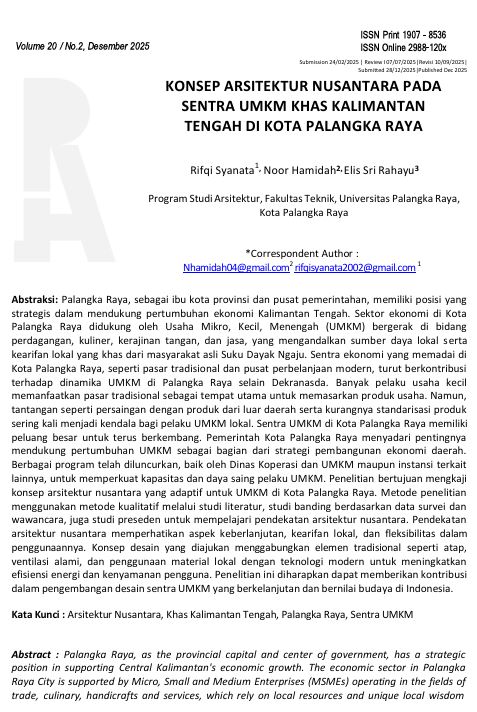
Palangka Raya, as the provincial capital and center of government, has a strategic position in supporting Central Kalimantan's economic growth. The economic sector in Palangka Raya City is supported by Micro, Small and Medium Enterprises (MSMEs) operating in the fields of trade, culinary, handicrafts and services, which rely on local resources and unique local wisdom
from the indigenous Dayak Ngaju tribe community. Adequate economic centers in Palangka Raya City, such as traditional markets and modern shopping centers, also contribute to the dynamics of MSMEs in Palangka Raya apart from Dekranasda. Many small businesses use traditional markets as the main place to market their products. However, challenges such as competition with products from outside the region and lack of product standardization often become obstacles for local MSME players. MSME centers in Palangka Raya City have great opportunities to continue to develop. The Palangka Raya City Government realizes the importance of supporting the growth of MSMEs as part of its regional economic development strategy. Various programs have been launched, both by the Department of Cooperatives and MSMEs and other related agencies, to strengthen the capacity and competitiveness of MSME players. The research aims to formulate an adaptive Indonesian architectural concept for the MSME Center in Palangka Raya City. The research method uses qualitative methods through literature studies, comparative studies based on survey and interview data, as well as precedent studies to study archipelago architectural approaches. The Indonesian architectural approach pays attention to aspects of sustainability, local wisdom and flexibility in its use. The proposed design concept combines traditional elements such as roofs, natural ventilation and the use of local materials with modern technology to increase energy efficiency and user comfort. It is hoped that this research can contribute to the development of sustainable and culturally valuable MSME center designs in Indonesia.
Downloads
References
[1] Belinda Azzahra (2021). Strategi Optimalisasi Standar Kinerja UMKM sebagai Katalis Perekonomian Indonesia dalam Menghadapi Middle Income. Inspire Journal: Economic and Development Analysis Vol. 1, No. 1, Hal. 99-111.
[2] Martina Rahmawati Masitoh (2023). Workshop Bagi Peningkatan Kreativitas Pada UMKM Kerajinan Tangan dari Manik-manik. Jurnal Pengabdian Masyarakat (JUPEMA) Vol. 2 No.2. Hal. 21-29.
[3] Riki Martusa, Meythi Maythi, Yolla Margaretha, Sri Zaniarti, Henky Lisan Suwarno (2024) Aksara: Jurnal Ilmu Pendidikan Nonformal Vol. 1, No. 1, Hal. 91-97.
[4] Bakhtiar (2014). Tipe Teori Pada Arsitektur Nusantara Menurut Josef Prijotomo.
Media Matrasain Volume 11 No.2, Hal 32-47.
[5] Nur Wanita (2015) Perkembangan Usaha Mikro, Kecil dan Menengah (UMKM) di Pasar Manonda Palu. Istiqra Jurnal Penelitian Ilmiah Volume 3 No. 2 Hal, 250- 279.
[6] Musran Munizu (2023). Peran Pemerintah Dalam Meningkatkan Daya Saing UMKM di Indonesia. Jambi: PT Sonmedia Publishing Indonesia.
[7] Florensa V, Hamidah N, Susi T. (2023) Perancangan Agrowisata Di Desa Hurung Bunut Kabupaten Gunung Mas. Sinektika Jurnal Arsitektur Vol.27 No.1. Hal 67-76.
[8] Undang-Undang Nomor 10 Tahun 2009 tentang Kepariwisataan
[9] Hamidah, N., Desna Ambarita, Ave Harysakti, Anna Rusdanisari. (2024). Perancangan
Pusat Industri Kreatif di Kabupaten Samosir. Jurnal Perspektif Arsitektur Vol. 18 No. 2 Hal. 35-44.
[10] Hamidah N., dkk. 2021. Merancang Museum Sejarah Kota Seribu Sungai di Kota Banjarmasin. Jurnal Teknik, Volume 15, Nomor 2, Oktober 2021, hal : 120-129.
[11] Hamidah, N., & Santoso, M. (2021). Survival of Urban People: Lesson Learn From Kampung Pahandut People, Palangkaraya City. IOP Conference Series: Earth and Environmental Science. IOP Publishing, p. 12-22.
[12] Hamidah N., dkk. 2022. Resort Berbasis Perkampungan Tradisional Batak Toba Di Kabupaten Humbang Hasundutan. Jurnal Perspektif Arsitektur, Volume 14, Nomor 2, Desember 2022, hal : 75-86.
[13] Malber J, C. 2021. Museum Budaya Batak di Parapat Kabupaten Simalungun, Tugas Akhir di Jurusan Arsitektur FT-UPR, Tidak Dipublikasikan.
[14] Doddy Soedigdo, Ave Harysakti, Tari Budayanti Usop (2014). Elemen-Elemen Pendorong Kearifan Lokal Pada Arsitektur Nusantara. Jurnal Perspektif Arsitektur Volume 9 No.1, Hal 37-47.
[15] Hamidah N., & Garib T. W. (2020). Betang Tipomorfologi Permukiman Kalimantan Tengah. Penerbit PT. Kanisius Yogyakarta.
[16] Groat, L. and D. Wang (2000). Architectural Research Methods. John Wiley&Sons, New York.
[17] Sarwono, J. (2006). Metode Penelitian Kuantitatif dan Kualitiatif. Graha Ilmu. Yogyakarta.
[18] Rifqi Syanata. (2025). Perancangan Senta Usaha Mikro, Kecil, Menegah (UMKM) Khas Kalimantan Tengah Di Kota Palangka Raya. Tugas Akhir tidak dipublikasi. Prodi/Jurusan Arsitektur, Fakultas Teknik, Universitas Palangka Raya. Hal 1-157.
Downloads
Published
How to Cite
Issue
Section
License
Copyright (c) 2025 RIFQI SYANATA, Noor Hamidah

This work is licensed under a Creative Commons Attribution 4.0 International License.