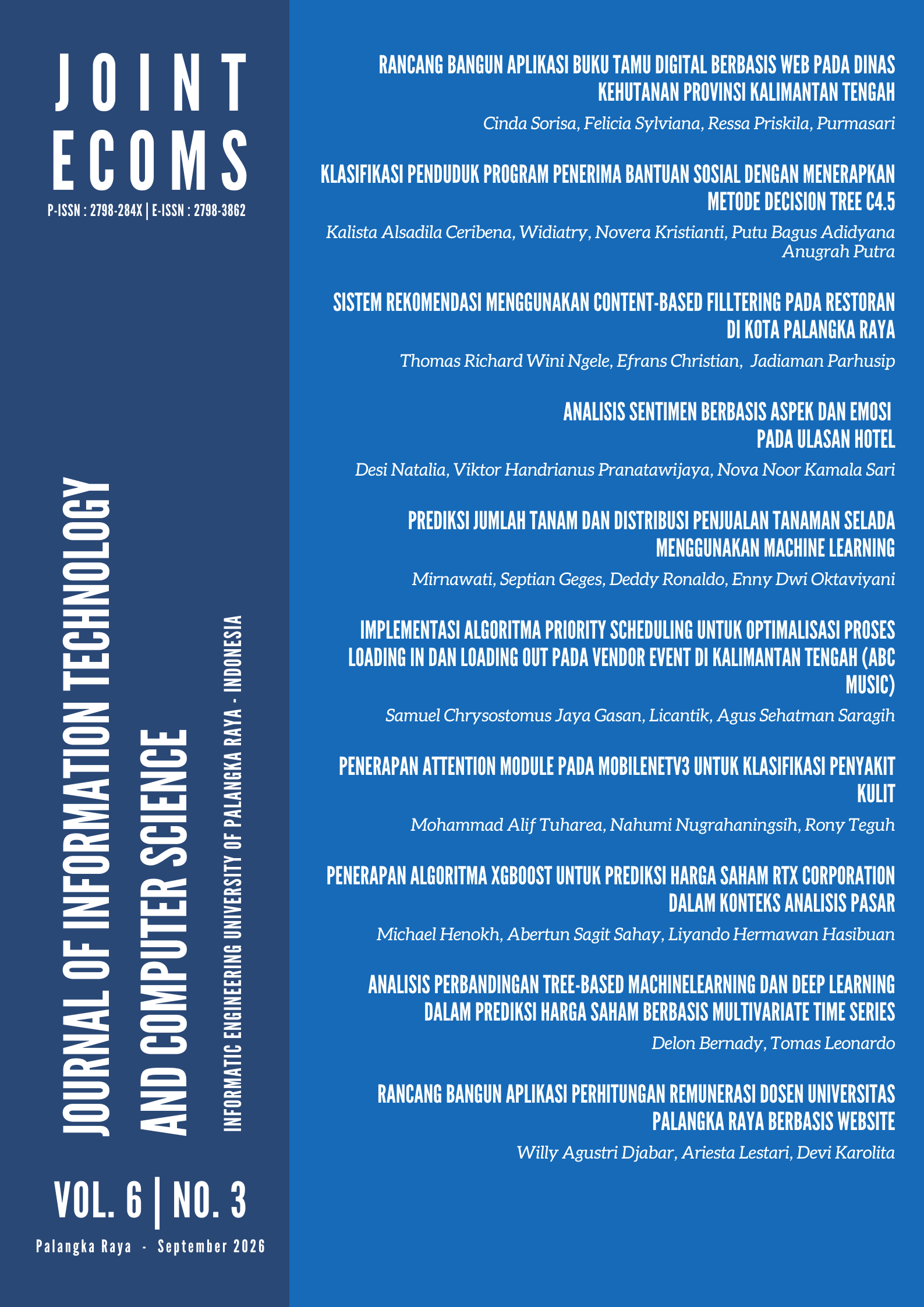
Penerapan Attention Module pada MobileNetV3 untuk Klasifikasi Penyakit Kulit
DOI:
https://doi.org/10.47111/jointecoms.v6i3.28442Keywords:
Penyakit kulit, MobileNetV3, Convolutional Block Attention Module (CBAM), IntegrasiAbstract
Penyakit kulit merupakan masalah kesehatan global yang signifikan. Berdasarkan data International League of Dermatological Societies (ILDS), terdapat 4,69 miliar kasus pada tahun 2021 yang menjadikannya penyebab keempat beban non-fatal terbesar di dunia. Diagnosis tradisional sangat bergantung pada pengalaman dan subjektivitas tenaga medis, sehingga diperlukan pendekatan berbasis komputasi cerdas.
Penelitian ini mengusulkan integrasi Convolutional Block Attention Module (CBAM) pada arsitektur MobileNetV3 untuk meningkatkan akurasi klasifikasi penyakit kulit. Tiga konfigurasi diuji: (a) CBAM setelah Inverted Residual Block dengan SE Block di dalamnya (CBAM A), (b). CBAM setelah SE Block (CBAM B), dan (c) CBAM menggantikan SE Block. Dataset yang digunakan merupakan gabungan tiga dataset publik dengan total 17.467 gambar dari 28 kelas penyakit dengan distribusi tidak seimbang. Model dilatih menggunakan transfer learning dengan pembekuan backbone, dievaluasi pada data uji tidak seimbang melalui lima kali pengulangan seed berbeda. Performa model dievaluasi dengan metrik accuracy, precision, recall, dan F1-Score. Selain itu, model dianalisis dengan uji‑t berpasangan.
Hasil eksperimen menunjukkan bahwa penempatan CBAM setelah SE Block (CBAM B) menghasilkan peningkatan performa tertinggi secara signifikan (berdasarkan paired t-test dan uji signifikansi statistik) dengan akurasi 0,4768 ± 0,0133, precision 0,4635 ± 0,0168, recall 0,4898 ± 0,0136, dan F1-Score 0,4721 ± 0,0156. Konfigurasi CBAM A justru menurunkan performa secara drastis, sedangkan CBAM C menghasilkan performa di bawah baseline. Penelitian ini menegaskan bahwa integrasi CBAM dapat meningkatkan performa model MobileNetV3 dengan pertimbangan bahwa posisi integrasi sangat mempengaruhi efektivitasnya dalam arsitektur CNN ringan.
Downloads
References
[1] A. Irjayanti, A. Wambrauw, I. Wahyuni, and A. A. Maranden, “Personal Hygiene with the Incidence of Skin Diseases,” Jurnal Ilmiah Kesehatan Sandi Husada, vol. 12, no. 1, pp. 169–175, Jun. 2023, doi: 10.35816/jiskh.v12i1.926.
[2] S. S. Mohammed and J. M. Al-Tuwaijari, “Skin Disease Classification System Based on Machine Learning Technique: A Survey,” IOP Conf. Ser. Mater. Sci. Eng., vol. 1076, no. 1, p. 012045, Feb. 2021, doi: 10.1088/1757-899x/1076/1/012045.
[3] Z. Ullah, M. Hong, T. Mahmood, and J. Kim, “Systematic Integration of Attention Modules into CNNs for Accurate and Generalizable Medical Image Classification,” Mathematics, vol. 13, no. 22, Nov. 2025, doi: 10.3390/math13223728.
[4] A. Aboulmira, H. Hrimech, and M. Lachgar, “Comparative Study of Multiple CNN Models for Classification of 23 Skin Diseases,” International journal of online and biomedical engineering, vol. 18, no. 11, pp. 127–142, 2022, doi: 10.3991/ijoe.v18i11.32517.
[5] S. A. Hanum, A. Dey, and M. A. Kabir, “An Attention-Guided Deep Learning Approach for Classifying 39 Skin Lesion Types,” Jan. 2025, [Online]. Available: http://arxiv.org/abs/2501.05991
[6] Hartatik, A. Aziz, R. Hartono, and R. Abdilah, “Decision Support System for Detection of Skin Diseases in Smart Health development planning,” in IOP Conference Series: Materials Science and Engineering, Institute of Physics Publishing, Jul. 2020. doi: 10.1088/1757-899X/858/1/012051.
[7] S. Indolia, A. K. Goswami, S. P. Mishra, and P. Asopa, “Conceptual Understanding of Convolutional Neural Network- A Deep Learning Approach,” in Procedia Computer Science, Elsevier B.V., 2018, pp. 679–688. doi: 10.1016/j.procs.2018.05.069.
[8] A. G. Howard et al., “MobileNets: Efficient Convolutional Neural Networks for Mobile Vision Applications,” Apr. 2017, [Online]. Available: http://arxiv.org/abs/1704.04861
[9] A. Howard et al., “Searching for MobileNetV3,” Nov. 2019, [Online]. Available: http://arxiv.org/abs/1905.02244
[10] J. Wang et al., “Integrating Biological and Machine Intelligence: Attention Mechanisms in Brain-Computer Interfaces,” Jul. 2025, [Online]. Available: http://arxiv.org/abs/2502.19281
[11] Z. Zhang and M. Wang, “Convolutional Neural Network with Convolutional Block Attention Module for Finger Vein Recognition,” Feb. 2022, [Online]. Available: http://arxiv.org/abs/2202.06673
[12] S. Woo, J. Park, J.-Y. Lee, and I. S. Kweon, “CBAM: Convolutional Block Attention Module.”
[13] M.-H. Guo et al., “Attention Mechanisms in Computer Vision: A Survey,” Nov. 2021, doi: 10.1007/s41095-022-0271-y.
[14] S. Sathyanarayanan and B. R. Tantri, “Confusion Matrix-Based Performance Evaluation Metrics,” African Journal of Biomedical Research, pp. 4023–4031, Nov. 2024, doi: 10.53555/ajbr.v27i4s.4345.
[15] J. C. Obi, “A comparative study of several classification metrics and their performances on data,” World Journal of Advanced Engineering Technology and Sciences, vol. 8, no. 1, pp. 308–314, Feb. 2023, doi: 10.30574/wjaets.2023.8.1.0054.
[16] S. Beddar-Wiesing, A. Moallemy-Oureh, M. Kempkes, and J. M. Thomas, “Absolute Evaluation Measures for Machine Learning: A Survey,” Jul. 2025, [Online]. Available: http://arxiv.org/abs/2507.03392
[17] O. Rainio, J. Teuho, and R. Klén, “Evaluation metrics and statistical tests for machine learning,” Sci. Rep., vol. 14, no. 1, Mar. 2024, doi: 10.1038/s41598-024-56706-x.
[18] M. C. Hinojosa Lee, J. Braet, and J. Springael, “Performance Metrics for Multilabel Emotion Classification: Comparing Micro, Macro, and Weighted F1-Scores,” Applied Sciences (Switzerland), vol. 14, no. 21, Nov. 2024, doi: 10.3390/app14219863.
[19] C. Andrade, “The P value and statistical significance: Misunderstandings, explanations, challenges, and alternatives,” May 01, 2019, Wolters Kluwer Medknow Publications. doi: 10.4103/IJPSYM.IJPSYM_193_19.
[20] R. Akbar, U. S. Sukmawati, and K. Katsirin, “Analisis Data Penelitian Kuantitatif,” Jurnal Pelita Nusantara, vol. 1, no. 3, pp. 430–448, Jan. 2024, doi: 10.59996/jurnalpelitanusantara.v1i3.350.
[21] A. Dhianti Putri, R. Sayyida Hilmia, S. Almaliyah, S. Permana, and P. Studi Bimbingan dan Konseling, “PENGAPLIKASIAN UJI T DALAM PENELITIAN EKSPERIMEN,” Lebesgue: Jurnal Ilmiah Pendidikan Matematika, Matematika dan Statistika, vol. 4, no. 3, pp. 1978–1987, Dec. 2023, doi: 10.46306/lb.v4i3.
[22] A. I. Talikan et al., “ON PAIRED SAMPLES T-TEST: APPLICATIONS, EXAMPLES AND LIMITATIONS,” Ignatian International Journal for Multidisciplinary Research, pp. 943–951, Apr. 2024, doi: 10.5281/zenodo.10987546.
[23] Nuryadi, T. D. Astuti, E. S. Utami, and M. Budiantara, DASAR-DASAR STATISTIK PENELITIAN. Yogyakarta: SIBUKU MEDIA, 2017. [Online]. Available: www.sibuku.com
[24] S. Kwak, “Are Only p-Values Less Than 0.05 Significant? A p-Value Greater Than 0.05 Is Also Significant!,” J. Lipid Atheroscler., vol. 12, no. 2, pp. 89–95, May 2023, doi: 10.12997/jla.2023.12.2.89.
[25] H. Bichri, A. Chergui, and M. Hain, “Investigating the Impact of Train / Test Split Ratio on the Performance of Pre-Trained Models with Custom Datasets,” 2024. [Online]. Available: www.ijacsa.thesai.org
[26] A. Mikołajczyk-Bareła, M. Ferlin, and M. Grochowski, “Targeted data augmentation for improving model robustness against systematic bias,” Mar. 11, 2024. doi: 10.21203/rs.3.rs-3953661/v1.
Downloads
Published
How to Cite
Issue
Section
License
Copyright (c) 2026 Journal of Information Technology and Computer Science

This work is licensed under a Creative Commons Attribution-NonCommercial-ShareAlike 4.0 International License.