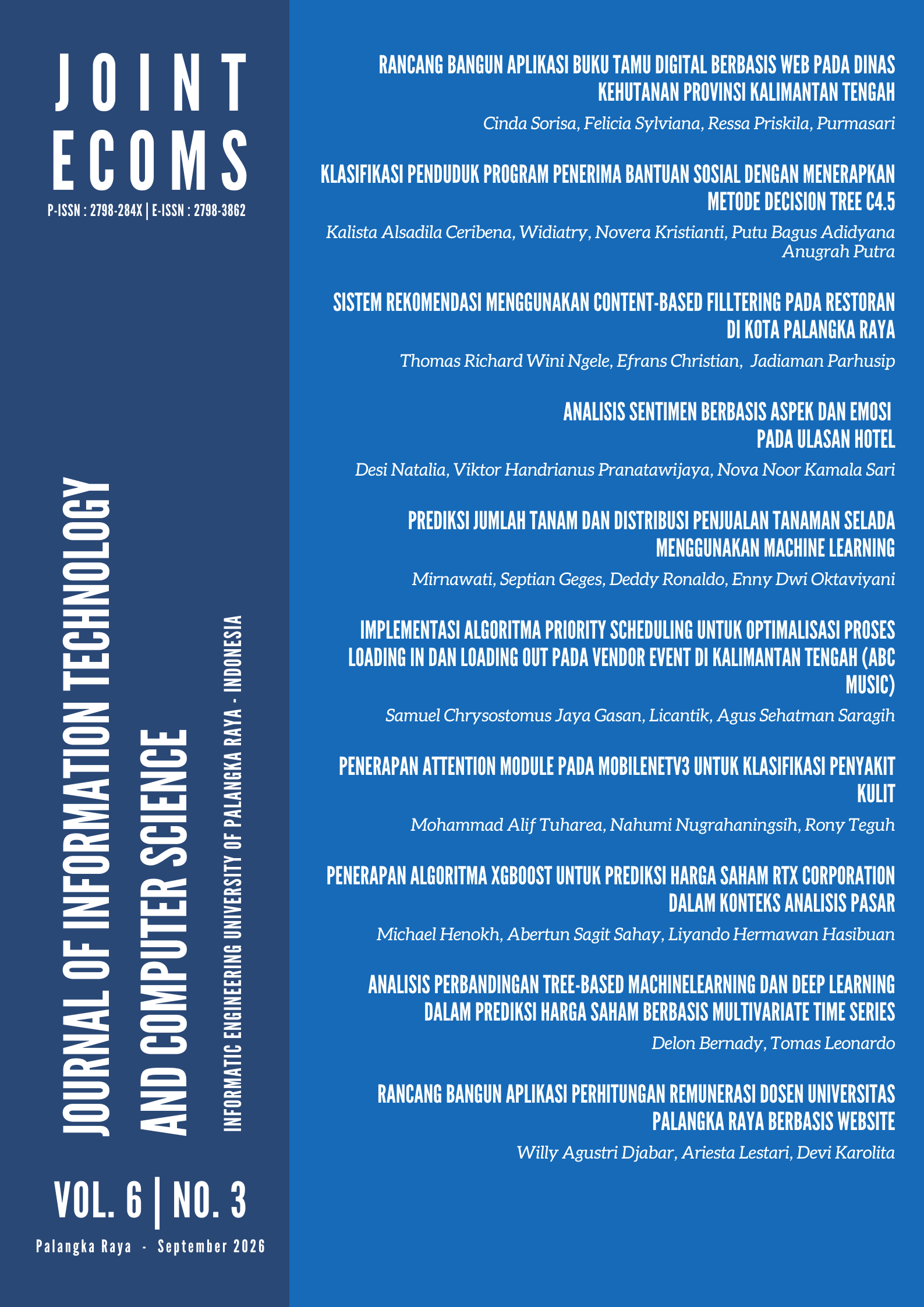
Analisis Perbandingan Tree-Based Machine Learning dan Deep Learning dalam Prediksi Harga Saham Berbasis Multivariate Time Series
DOI:
https://doi.org/10.47111/jointecoms.v6i3.28445Keywords:
Prediksi Harga Saham, Tree-Based Machine Learning, Deep Learning, PatchTST, XGBoost, Multivariate Time SeriesAbstract
Penelitian ini membandingkan XGBoost dan PatchTST dalam memprediksi harga saham PT Medco Energi Internasional Tbk (MEDC) menggunakan pendekatan multivariate time series. Data yang digunakan meliputi riwayat harga saham MEDC, Indeks Harga Saham Gabungan (IHSG), harga minyak mentah WTI, indikator teknikal, dan sentimen berita. Mutual Information digunakan untuk melakukan seleksi fitur, sedangkan kinerja model dievaluasi menggunakan eight-fold walk-forward validation dengan rolling window. Metrik evaluasi yang digunakan meliputi RMSE, MAE, MAPE, R², dan CV, serta didukung oleh analisis feature importance, SHAP, dan Wilcoxon Signed-Rank Test dengan koreksi Bonferroni. Secara umum, PatchTST menunjukkan kinerja dan stabilitas yang lebih baik dibandingkan XGBoost. Konfigurasi PatchTST FS8 menghasilkan nilai RMSE terendah sebesar 53,56, MAE sebesar 41,20, MAPE sebesar 5,19%, dan R² sebesar 0,8710. Sementara itu, XGBoost FS8 menghasilkan RMSE sebesar 90,89, MAE sebesar 67,69, MAPE sebesar 6,82%, dan R² sebesar 0,6184. Namun, hasil pengujian Wilcoxon menunjukkan bahwa perbedaan kinerja kedua model tersebut tidak signifikan secara statistik setelah penerapan koreksi Bonferroni. Analisis fitur mengidentifikasi Terakhir_MEDC_Lag_1 sebagai fitur yang secara konsisten memiliki pengaruh dominan, sedangkan sentimen berita memberikan kontribusi yang relatif rendah.
Downloads
References
[1] X. Ji, J. Wang, and Z. Yan, “A stock price prediction method based on deep learning technology,” International Journal of Crowd Science, vol. 5, no. 1, pp. 55–72, Apr. 2021, doi: 10.1108/IJCS-05-2020-0012.
[2] K. Kwanda, D. E. Herwindiati, M. D. Lauro, and K. K. C. Id, “Perbandingan LSTM dan Bidirectional LSTM pada Sistem Prediksi Harga Saham Berbasis Website,” R2J, vol. 7, no. 1, 2024, doi: 10.38035/rrj.v7i1.
[3] I. Karijadi, Y. Widjaja, D. Retno, S. Dewi, and L. J. Asrini, “Studi Penerapan Deep Learning untuk Prediksi Pergerakan Indeks Harga Saham Gabungan,” Jurnal Impresi Indonesia (JII), vol. 4, no. 12, 2025.
[4] K. N. Hermawan, “Pengaruh Harga Minyak Mentah dan Struktur Modal terhadap Profitabilitas Perusahaan Sektor Energi yang Terdaftar di Indeks Saham Syariah Indonesia (ISSI),” Indonesian Journal of Economics, vol. 1, no. 9, 2024.
[5] S. Mazya Permataning Tyas, R. Sarno, and B. Setya Rintyarna, “Analisis Perbandingan Metode Klasifikasi Sentimen Berita Saham: Pendekatan Machine Learning, Deep Learning, Transfer Learning, dan Graf,” 2024.
[6] L. Hu et al., “Supervised Machine Learning Techniques: An Overview with Applications to Banking Corporate Model Risk, Wells Fargo,” International Statistical Review, vol. 89, pp. 573–604, 2020, doi: 10.1111/insr.12448.
[7] Q. Wen et al., “Transformers in Time Series: A Survey,” in Proceedings of the Thirty-Second International Joint Conference on Artificial Intelligence (IJCAI-23), 2023. doi: 10.24963/ijcai.2023/759.
[8] S. Yongchareon, “AI-Driven Intelligent Financial Forecasting: A Comparative Study of Advanced Deep Learning Models for Long-Term Stock Market Prediction,” Mach. Learn. Knowl. Extr., vol. 7, no. 3, Sep. 2025, doi: 10.3390/make7030061.
[9] J. M. A. S. Dachi and P. Sitompul, “Analisis Perbandingan Algoritma XGBoost dan Algoritma Random Forest Ensemble Learning pada Klasifikasi Keputusan Kredit,” JURNAL RISET RUMPUN MATEMATIKA DAN ILMU PENGETAHUAN ALAM, vol. 2, no. 2, pp. 65–71, Jul. 2023, doi: 10.55606/jurrimipa.v2i2.1336.
[10] S. Rohman, I. Wiseto, and P. Agung, “KOMPARASI ALGORITMA INDOBERT, SVM, DAN RANDOM FOREST DALAM ANALISIS SENTIMEN PROGRAM MAKAN BERGIZI GRATIS,” 2025.
[11] F. Alvin, N. Anisa, and S. Winarsih, “Perbandingan Kinerja Model IndoBERT, IndoBERTweet, dan Algoritma Klasik pada Analisis Sentimen Isu Indonesia Gelap,” Technology and Science (BITS), vol. 7, no. 3, pp. 1601–1613, 2025, doi: 10.47065/bits.v7i3.8636.
[12] S. Rohman, I. Wiseto, and P. Agung, “KOMPARASI ALGORITMA INDOBERT, SVM, DAN RANDOM FOREST DALAM ANALISIS SENTIMEN PROGRAM MAKAN BERGIZI GRATIS,” 2025.
[13] A. R. Aisy and G. Karyono, “Analisis Sentimen Terhadap Ulasan Google Play Store Aplikasi Lazada, Shopee, dan Tokopedia Menggunakan Algoritma IndoBERT,” Technology and Science (BITS), vol. 7, no. 3, 2025, doi: 10.47065/bits.v7i3.8745.
[14] S. Alam, Z. Suryady, and A. Kusnadi, “Fine-Tuning IndoBERT Untuk Analisis Sentimen Berita Saham Berbahasa Indonesia Dengan Hyperparameter Optimization,” JTERA (Jurnal Teknologi Rekayasa), vol. 11, no. 1, Jun. 2026, doi: 10.31544/jtera.v11.i1.2026.51-60.
[15] N. N. Azizah, W. D. Utami, and A. Fanani, “Algoritma XGBoost Untuk Analisis Prediksi Permintaan Kalibrasi di PT PAL Indonesia,” JIKO (Jurnal Informatika dan Komputer), vol. 10, no. 1, p. 14, Feb. 2026, doi: 10.26798/jiko.v10i1.2245.
[16] B. Jange, “Prediksi Harga Saham Bank BCA Menggunakan XGBoost,” ARBITRASE: Journal of Economics and Accounting, vol. 3, no. 2, pp. 231–237, Nov. 2022, doi: 10.47065/arbitrase.v3i2.495.
[17] L. Huang, X. Zhou, L. Shi, and L. Gong, “Time Series Feature Selection Method Based on Mutual Information,” Applied Sciences (Switzerland), vol. 14, no. 5, Mar. 2024, doi: 10.3390/app14051960.
[18] M. Hisyam, Z. Fitri, and H. A. K. Aidilof, “Implementasi Algoritma XGBoost dengan Walk Forward Validation untuk Prediksi Harga Emas Antam,” JURIKOM (Jurnal Riset Komputer), vol. 12, no. 4, pp. 403–413, Aug. 2025, doi: 10.30865/jurikom.v12i4.8693.
[19] H. Hewamalage, K. Ackermann, and C. Bergmeir, “Forecast evaluation for data scientists: common pitfalls and best practices,” Data Min. Knowl. Discov., vol. 37, no. 2, pp. 788–832, Mar. 2023, doi: 10.1007/s10618-022-00894-5.
[20] E. Fortuna, D. Arman Prasetya, and K. Maulida Hindrayani, “X-Means Clustering for Segmenting Property Customer Payment Behaviors,” Journal of Information System and Technology Research journal homepage, vol. 5, no. 1, 2026, doi: 10.55537/jistr.v5i1.1228.
[21] M. A. Rayadin, M. Musaruddin, R. A. Saputra, and I. Isnawaty, “Implementasi Ensemble Learning Metode XGBoost dan Random Forest untuk Prediksi Waktu Penggantian Baterai Aki,” BIOS : Jurnal Teknologi Informasi dan Rekayasa Komputer, vol. 5, no. 2, pp. 111–119, Aug. 2024, doi: 10.37148/bios.v5i2.128.
[22] M. Syukron, “A Patch-Based Transformer Approach to Nonlinear Dynamics Natural Gas Price Forecasting,” (IJCSAM) INTERNATIONAL JOURNAL OF COMPUTING SCIENCE AND APPLIED MATHEMATICS, vol. 11, pp. 76–82, Dec. 2025, doi: 10.12962/j24775401.ijcsam.v11i2.8849.
[23] G. Mo, W. Jia, C. Tan, W. Zhang, and J. Rong, “Risk Prediction of International Stock Markets with Complex Spatio-Temporal Correlations: A Spatio-Temporal Graph Convolutional Regression Model Integrating Uncertainty Quantification,” vol. 18, p. 488, 2025, doi: 10.3390/jrfm18090488.
[24] S. F. Stumpfe and S. C. Shongwe, “Comparative Analysis and Optimisation of Machine Learning Models for Regression and Classification on Structured Tabular Datasets,” Mathematics, vol. 14, no. 3, Feb. 2026, doi: 10.3390/math14030473.
[25] J. Wainer, “A Bayesian Bradley-Terry model to compare multiple ML algorithms on multiple data sets,” Journal of Machine Learning Research, vol. 24, pp. 1–34, 2023, doi: 10.48550/arXiv.2208.04935.
[26] K. Wallapure Manikrao, S. Allagi, W. Y. Leong, and M. Laddi, “An Explainable AI for Stock Market Prediction: A Machine Learning Approach with XAI and Deep Neural Networks,” Journal of Computational and Cognitive Engineering, Dec. 2025, doi: 10.47852/bonviewjcce52026428.
Downloads
Published
How to Cite
Issue
Section
License
Copyright (c) 2026 Journal of Information Technology and Computer Science

This work is licensed under a Creative Commons Attribution-NonCommercial-ShareAlike 4.0 International License.