GREEN ARCHITECTURE APPROACH IN THE DESIGN OF THE UNIVERSITY OF PALANGKA RAYA BUSINESS INCUBATOR CENTER BASED ON LOCAL POTENTIAL
Variabel & Kriteria
DOI:
https://doi.org/10.36873/jpa.v20i02.20809Keywords:
Business Incubator Center, green architecture, Local Potential, Architectural Design, University Of Palangka RayaAbstract
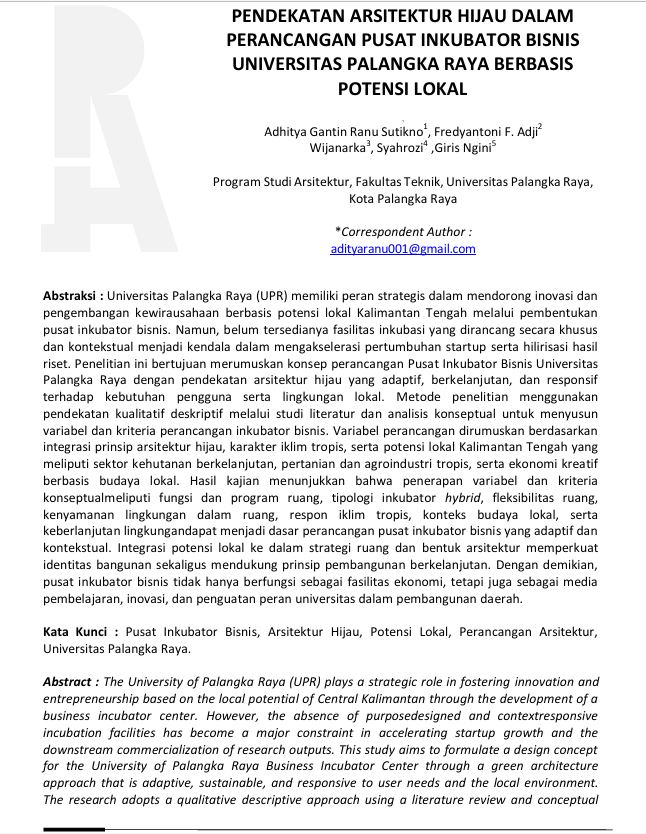
The University of Palangka Raya (UPR) plays a strategic role in fostering innovation and entrepreneurship based on the local potential of Central Kalimantan through the development of a business incubator center. However, the absence of purposedesigned and contextresponsive incubation facilities has become a major constraint in accelerating startup growth and the downstream commercialization of research outputs. This study aims to formulate a design concept for the University of Palangka Raya Business Incubator Center through a green architecture approach that is adaptive, sustainable, and responsive to user needs and the local environment. The research adopts a qualitative descriptive approach using a literature review and conceptual analysis to establish design variables and criteria for the business incubator. The design framework is developed through the integration of green architecture principles, tropical climatic characteristics, and the local potential of Central Kalimantan, including sustainable forestry, tropical agriculture and agroindustry, and culturebased creative economy sectors.The findings indicate that the application of conceptual variables and design criteriacomprising spatial functions and programs, hybrid incubator typology, spatial flexibility, indoor environmental comfort, tropical climate responsiveness, local cultural context, and environmental sustainabilitycan serve as a foundation for designing an adaptive and contextsensitive business incubator center. The integration of local potential into spatial strategies and architectural form strengthens the building’s identity while supporting sustainable development principles. Thus, the business incubator functions not only as an economic facility but also as a medium for learning, innovation, and the reinforcement of the university’s role in regional development.
Downloads
References
[1] O. Sukmana et al., Pendidikan Vokasi: Kompetensi & Solusi Kebutuhan Dunia Kerja. , Star Digital Publishing, 2025.
[2] R. Sarman, “Sinergi pendidikan inklusif dan kewirausahaan inovatif sebagai strategi mewujudkan visi Indonesia Emas tahun 2045,” Unpubl. Manuscr., 2023.
[3] M. Mustafa, “Penerapan Prinsip Arsitektur Hijau Pada Desain Permukiman Ramah Lingkungan di Perkotaan,” J. Cahaya Mandalika ISSN 2721-4796, vol. 5, no. 2, pp. 623–632, 2024.
[4] N. Nasruddin, S. Mattiro, M. Ziyad, W. Firmansyah, and D. Stiadi, “KAJIAN PENGEMBANGANKEWIRAUSAHAAN PELAKU EKONOMI KREATIF MUDA PEMULA DI PROVINSI KALIMANTAN SELATAN.”
[5] C. Li, N. Ahmed, S. A. Qalati, A. Khan, and S. Naz, “Role of business incubators as a tool for entrepreneurship development: the mediating and moderating role of business start-up and government regulations,” Sustainability, vol. 12, no. 5, p. 1822, 2020.
[6] S. L. Yuana and U. A. Aziz, “Kuasa Dalam Rantai Industri Berbasis Inovasi.” 2017.
[7] N. K. S. Noriska, A. Puspitasari, V. Sulistyowati, M. Pusparisti, and A. Amborowati, “Penguatan Wirausaha Muda melalui Program Inkubasi Bisnis Youth Entrepreneur Prodi Manajemen Bisnis di Kota Surakarta,” J. Abdi Masy. Indones., vol. 5, no. 1, pp. 81–90, 2025.
[8] R. Hasbullah, M. Surahman, A. Yani, D. P. Almada, and E. N. Faizaty, “Peran inkubator bisnis perguruan tinggi dalam peningkatan kinerja usaha UKM pangan,” J. Ilmu Pertan. Indones., vol. 20, no. 1, pp. 59–65, 2015.
[9] D. N. Isopescu, “The impact of green building principles in the sustainable development of the built environment,” in IOP Conference Series: Materials Science and Engineering, 2018, vol. 399, no. 1, p. 12026.
[10] G. S. Mahendra et al., Green Technology: Panduan Teknologi Ramah Lingkungan. PT. Sonpedia Publishing Indonesia, 2024.
[11] M. M. Sudarwani, “Penerapan green architecture dan green building sebagai upaya pencapaian sustainable architecture,” Din. Sains, vol. 10, no. 24, 2012.
[12] Y. A. Dewi, “Inovasi spesifik lokasi untuk inkubator teknologi mendukung pengembangan ekonomi lokal,” Anal. Kebijak. Pertan., vol. 10, no. 4, pp. 299–312, 2012.
[13] A. D. Hariyanti et al., Arsitektur dan Lanskap. PT Bukuloka Literasi Bangsa, 2025.
Downloads
Published
How to Cite
Issue
Section
License
Copyright (c) 2025 Adhitya Gantin, Fredyantoni F. Adji, Wijanarka, Syahrozi, Giris Ngini

This work is licensed under a Creative Commons Attribution 4.0 International License.