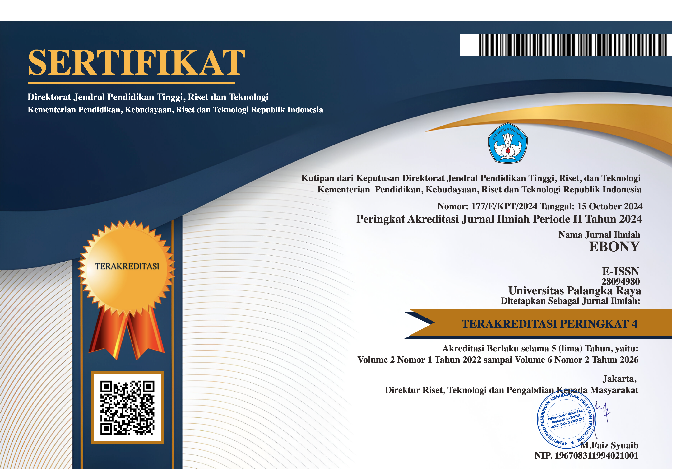
| SINTA-4 ACCREDITATION CERTIFICATE |
|
|
| MANUSCRIPT TEMPLATE |
 |
| ADDITIONAL MENU |
| TOOLS FOR AUTHORS |
 |
 |
 |
| SCOPUS CITEDNESS |

| VISITOR STATISTICS |

The following guidelines of Jurnal's Publication Ethics are in accordance with COPE’s guidelines of "Committee on Publication Ethics".
Editors play a critical role in the publication process, ensuring that Peer Review is conducted fairly, ethical standards are upheld, and the integrity of the journal is maintained. Their responsibilities extend to all stages of the publication process, from initial submission to final publication, and even post-publication. Below are the primary responsibilities of an editor:
1. Ensuring the Quality and Integrity of the Journal
Editors are responsible for maintaining the scientific rigor, quality, and credibility of the journal. They must ensure that only manuscripts with high scientific value are accepted for publication. This involves supervising the peer review process, evaluating whether the research is methodologically sound, and making decisions based on the merits of the work.
2. Fair and Impartial Decision-Making
Editors should make publication decisions based on scientific merit and research validity, free from bias. Their decisions should not be influenced by personal interests, relationships, or external pressures. They are expected to evaluate the manuscript objectively, taking into account its content and relevance to the journal's readers.
3. Ensure Ethical Review
Editors are responsible for upholding ethical standards in the peer review process. These include:
4. Ensuring Transparency in the Manuscript Review Process
Editors should ensure that the peer review process is transparent and that all parties (authors, Reviewer, and the editorial team) understand the procedure. In the case of revisions, editors should clearly communicate the reviewer's comments to the author and ensure that any substantial changes are clearly documented.
5. Maintain Confidentiality
Editors must treat all manuscripts and related materials as confidential. They must not disclose any information about the content of the manuscript to unauthorized persons. Editors must also ensure that Reviewer are bound by confidentiality agreements, especially when discussing or sharing manuscripts.
6. Conflict of Interest Management
Editors should avoid conflicts of interest that could harm the fairness of the manuscript review and decision-making process. They should disclose any conflicts of interest related to the manuscript and, if necessary, withdraw from the decision-making process if there is a conflict of interest with the manuscript received.
7. Author and Reviewer
Editors should offer guidance to authors and reviewers if there are any questions or concerns about the manuscript or the manuscript review process. This includes providing constructive feedback, offering support during the revision process, and mediating between authors and Peers in case of disagreements or misunderstandings.
8. Maintain Transparency in the Editorial Process
Editors are responsible for clearly communicating with authors about journal procedures, expectations, and schedules. This transparency helps ensure that the editorial process is fair and that all parties involved understand the steps and requirements of the review and publication process.
9. Publication Decision
Editors have the ultimate responsibility for accepting, revising, or rejecting manuscripts based on the quality of the work and feedback provided by the Reviewer. Editors must communicate their decisions clearly and provide transparent reasons for the rejection or the need for revisions. They must also ensure that decisions are made in a timely manner to avoid unnecessary delays for the author.
In summary, editors play a crucial role in ensuring the credibility, fairness, and ethical standards of the scientific publishing process. They are responsible for making impartial decisions, supporting authors and Peers, maintaining confidentiality, addressing ethical issues, and ensuring the quality and integrity of the journal as a whole.
In the publication ethics of scientific journals, Reviewer plays an important role in maintaining the integrity and quality of scientific works. Their responsibility is to evaluate the content of scientific manuscripts. Here are the details of Reviewer's main responsibilities in the publication process:
1. Objective and Confidential Reviews
Peers are expected to assess manuscripts impartially, basing their judgment solely on scientific merit, research validity, and relevance to the journal's scope. They should avoid bias or personal conflicts of interest. The Peer's review process is confidential, and Peers should not disclose the manuscript to others or use the information for personal gain.
2. Timeliness
Reviewer have the responsibility to complete their review within the agreed timeframe. If they are unable to meet the deadline due to commitments or other conflicts, they must notify the journal editor as soon as possible so that an alternative Reviewer can be assigned to replace the manuscript review process.
3. Confidentiality
As part of the publication ethics guidelines, Reviewer must treat all manuscripts and related materials as confidential. They must not share or discuss the manuscript with anyone outside the editorial team or use the ideas or data presented in the reviewed manuscript for their own research without proper authorization.
4. Constructive Feedback
Peers should provide constructive, clear, and specific feedback that helps authors improve their work. This feedback should focus on the scientific quality of the research, relevance, clarity, and adherence to ethical standards. Personal comments or criticism should be avoided, and the tone should always be professional and respectful.
5. Violation Detection
A Reviewer has a responsibility to flag potential ethical issues, such as plagiarism, data fabrication, authorship conflicts, or unethical research practices. If a Reviewer suspects that a manuscript violates ethical guidelines or includes questionable data, they should report it to the journal's editorial team.
6. Conflicts of Interest
Reviewer must disclose any conflicts of interest that may affect their ability to provide an impartial review. This includes financial relationships, personal relationships, or professional relationships with the author or manuscript subject. If there is a conflict of interest, the Reviewer must withdraw from the manuscript review process.
7. Maintaining Integrity
Reviewer must maintain the integrity of scientific records by providing honest and fair judgments. They must not allow personal or professional biases to influence their reviews. Additionally, they must refrain from any actions that could damage the author's reputation or career without just cause.
By fulfilling this responsibility, Reviewer play a key role in ensuring that the publication process remains fair, rigorous, and ethical, ultimately contributing to the advancement of credible scientific knowledge.
The responsibility of the author in the publication process is fundamental to maintaining the integrity, quality, and transparency of scientific research. Authors must adhere to strict ethical standards, both during the research and publication stages. Below are details about the main responsibilities of the author after publication:
1. Honesty and Accuracy in Research
Authors are responsible for ensuring that their research is accurate, valid, and based on sound scientific methods. This includes ensuring that the data is not fabricated, manipulated, or falsified. Authors must report findings honestly, without exaggeration or selective presentation of results to support previously formed conclusions.
2. Originality and Proper Quote
Authors should ensure that their work is original and not plagiarized. Proper attribution for previous work is essential, and authors should ensure that they cite any sources, ideas, or data that are not theirs. Plagiarism, whether intentional or not, is a serious violation of publication ethics.
3. Authorship and Acknowledgment
The author must approve the final manuscript and approve its contents. Individuals who contribute in a minor or non-scientific way must be acknowledged in the "Acknowledgements" section but not listed as an author. It is also important for the author to disclose any conflicts of interest that may affect the research.
4. Research Integrity and Ethical Approval
Authors are responsible for ensuring that their research complies with ethical standards, including obtaining the necessary approvals from the research institution or venue when necessary. This includes obtaining informed consent from participants or human objects in the research.
5. Data Availability and Transparency
Authors should make their data available to the public, or at least to other researchers, when necessary. This increases the transparency and reproducibility of scientific work. If data cannot be shared due to privacy concerns or other legitimate reasons, authors should make this clear in the manuscript.
6. Timely and Ethical Revisions
Authors are expected to respond to Reviewer's comments and criticisms quickly and thoroughly. Authors should revise their manuscripts according to the feedback provided. Revisions should be based on the principles of academic rigor and should improve the quality of the manuscript.
7. Avoid Duplicate Publications
Authors should avoid submitting the same manuscript or data to multiple journals for simultaneous publication (duplicate publications), unless the submission is clearly part of a larger multi-part study with proper explanation. They should also avoid publishing the same findings in multiple articles without stating the reasons clearly and providing the correct context.
8. Correcting Errors or Presentation Errors
If authors become aware of errors, inaccuracies, or omissions in their published work, they are responsible for notifying the journal immediately. They should work closely with the editorial team to issue corrections, retractions, or clarifications as necessary. This is important to maintain the accuracy and credibility of scientific publications.
9. Acknowledging Funding and Conflicts of Interest
Authors are responsible for disclosing any financial support they receive for research, as well as potential conflicts of interest that may be considered to affect the results of their research or interpretation. This transparency helps maintain trust in the scientific community.
In summary, authors assume significant ethical and professional responsibilities, from ensuring that their research is original and methodological to addressing errors or post-publication issues. Upholding this responsibility contributes to the trust and reliability of the scientific literature, which benefits the broader scientific community.
To declare in a signed form, authors are to fill in the STATEMENT OF ORIGINALITY & ETHICS.
| SINTA-4 ACCREDITATION CERTIFICATE |
|
|
| MANUSCRIPT TEMPLATE |
|
| ADDITIONAL MENU |
| TOOLS FOR AUTHORS |
|
|
|
| SCOPUS CITEDNESS |
| VISITOR STATISTICS |
Mailing Address:
Program Studi Pendidikan Bahasa Inggris, FKIP Universitas Palangka Raya
Jl. Hendrik Timang I-A Kampus UPR Tunjung Nyahu Palangka Raya 73112.
Email: ebony.pspbi@upr.ac.id
p-ISSN e-ISSN

EBONY: Journal of English Language Teaching, Linguistics, and Literature is licensed under a Creative Commons Attribution 4.0 International License.