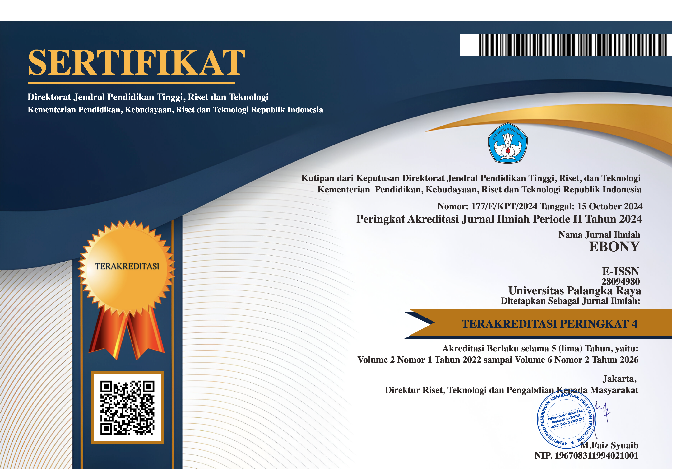
| SINTA-4 ACCREDITATION CERTIFICATE |
|
|
| MANUSCRIPT TEMPLATE |
 |
| ADDITIONAL MENU |
| TOOLS FOR AUTHORS |
 |
 |
 |
| SCOPUS CITEDNESS |

| VISITOR STATISTICS |

The following is the policy on the use of Artificial Intelligence (AI) such as ChatGPT or Large Language Models in the writing and publication of scholarly articles in EBONY-- Journal of English Language Teaching, Linguistics, and Literature. This policy is adapted from COPE, WAME, and JAMA Network to state that AI tools cannot be listed as an author of a paper.
1. Purpose and Scope
This policy establishes the principles and requirements governing the use of artificial intelligence (AI), including generative AI and AI-assisted technologies, in manuscript preparation, research activities, peer review, and editorial decision-making. The policy aims to uphold academic integrity, transparency, originality, confidentiality, and accountability in scholarly publishing.
This policy applies to all authors, co-authors, reviewers, editors, and other individuals involved in the publication process.
2. Use of AI by Authors
The journal permits the responsible use of AI tools to support manuscript preparation, provided that their use does not compromise academic integrity, research originality, or the validity of scholarly findings.
Permitted uses of AI include:
Authors must exercise appropriate human oversight and critically evaluate all AI-assisted outputs before incorporating them into a manuscript.
3. Prohibited and Unacceptable Uses of AI
AI must not be used in ways that undermine the integrity, authenticity, or credibility of scholarly work. Unacceptable practices include, but are not limited to:
Authors remain responsible for ensuring that their manuscripts comply with the journal's publication ethics, copyright requirements, and applicable research regulations.
4. AI Authorship and Accountability
AI tools cannot be credited as authors or co-authors. Authorship is reserved for individuals who meet the journal's authorship criteria and can accept responsibility for the work.
All listed authors are collectively responsible for the integrity of the submitted manuscript and individually accountable for their respective contributions. Authors must review and verify all AI-assisted content, including its accuracy, originality, references, interpretation, and compliance with ethical standards.
The use of AI does not diminish or transfer the authors' responsibility for the submitted or published work.
5. Disclosure of AI Use
Authors must disclose the use of generative AI or AI-assisted technologies when such tools contribute substantively to manuscript content, scholarly writing, research analysis, or the creation or modification of visual materials.
The disclosure must identify:
Routine use of basic spelling, punctuation, or grammar-checking tools that does not substantively alter the manuscript's content does not require a declaration, unless otherwise required by the journal.
Authors who have not used AI in preparing the manuscript may provide a declaration confirming that no generative AI or AI-assisted technology was used in a manner requiring disclosure under this policy.
6. AI-Generated Images, Figures, and Other Materials
The use of AI to generate, modify, or enhance images, figures, illustrations, and other visual materials must be transparent and must comply with applicable copyright, licensing, and ethical requirements.
Authors must disclose substantive AI involvement in the creation or modification of visual materials, including the tool used and the nature of its contribution. Any visual material presented as empirical evidence must accurately represent the underlying research data and must not mislead readers.
The journal reserves the right to request original files, source data, or further documentation to verify the authenticity and integrity of submitted materials.
7. Use of AI by Reviewers
Peer reviewers must maintain the confidentiality of submitted manuscripts and the independence of their scholarly evaluations.
Reviewers must not upload submitted manuscripts, unpublished research data, figures, tables, or identifiable manuscript content to external AI systems when doing so could compromise confidentiality, intellectual property, or data protection.
AI must not replace the reviewer's independent critical assessment, evaluation of methodological rigor, or scholarly judgment. Reviewers remain responsible for the accuracy, fairness, and integrity of their review reports.
Where permitted by the journal, limited AI assistance for language editing or improving the clarity of a review report may be used only when confidentiality is preserved and the use is disclosed to the editor.
8. Use of AI by Editors
Editors must protect the confidentiality of submitted manuscripts and maintain independent, fair, and evidence-based editorial decision-making.
Editors must not upload confidential manuscript content or unpublished research materials to external AI systems in ways that could compromise confidentiality, intellectual property, or data protection.
AI must not replace editorial judgment in decisions concerning peer review, acceptance, rejection, research integrity, or publication ethics. Editors remain fully accountable for editorial decisions and communications.
Any AI assistance used in editorial administration must comply with this policy and the journal's confidentiality requirements.
9. Editorial Assessment and Consequences of Misuse
The journal reserves the right to assess disclosed or suspected AI use when necessary to determine compliance with this policy.
Where concerns arise, the journal may request clarification, disclosure statements, supporting documentation, original research materials, or other relevant evidence from the authors.
Depending on the nature and severity of the violation, the journal may:
Editorial decisions will be based on the nature of the violation, the available evidence, and the journal's established ethical procedures. The use of AI alone does not automatically constitute misconduct; undisclosed, deceptive, or inappropriate use will be assessed in context.
10. Policy Review and Updates
The journal recognizes that AI technologies and scholarly publishing standards continue to evolve. This policy may be revised periodically to reflect developments in research integrity, publication ethics, and responsible AI use.
All authors, reviewers, and editors are expected to comply with the version of the policy applicable to their manuscript or editorial assignment.
By submitting a manuscript to the journal, authors acknowledge their responsibility to comply with this policy and to disclose relevant AI use as required.
11. Recommended AI Disclosure Statement
All authors are required to complete the attached AI Disclosure Form, regardless of whether they have used AI tools in preparing their manuscripts. Please download and fill out the following form. The editor may request the completed form during the editorial process.
Download this: AI Disclosure Form
| SINTA-4 ACCREDITATION CERTIFICATE |
|
|
| MANUSCRIPT TEMPLATE |
|
| ADDITIONAL MENU |
| TOOLS FOR AUTHORS |
|
|
|
| SCOPUS CITEDNESS |
| VISITOR STATISTICS |
Mailing Address:
Program Studi Pendidikan Bahasa Inggris, FKIP Universitas Palangka Raya
Jl. Hendrik Timang I-A Kampus UPR Tunjung Nyahu Palangka Raya 73112.
Email: ebony.pspbi@upr.ac.id
p-ISSN e-ISSN

EBONY: Journal of English Language Teaching, Linguistics, and Literature is licensed under a Creative Commons Attribution 4.0 International License.