Submit Manuscript And Contact
Download Template Article
Governing Body & Contact
Editorial Policies
Submission
Additional Information
Reference Manager
Plagiarism Cheker
Partner Collaboration
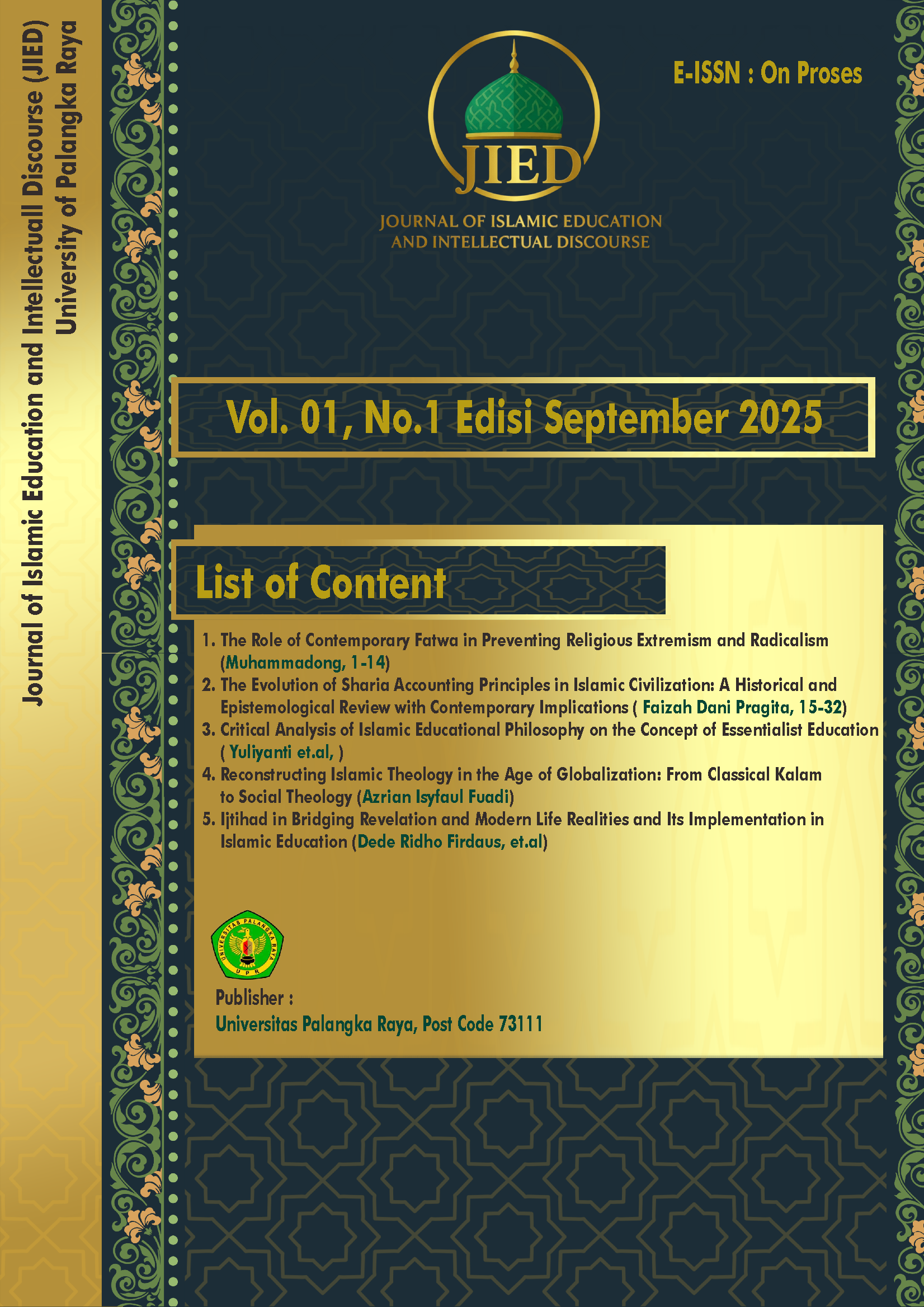
The Journal of Islamic Education and Intellectual Discourse (JIED) Volume 1, Issue 1, September 2025 presents a collection of articles that collectively highlight a strong scholarly orientation toward advancing research in Islamic education and the Islamic intellectual tradition, promoting dialogue between classical scholarship and contemporary paradigms, and fostering the renewal of Islamic thought rooted in ethical, spiritual, and intellectual values—fully aligned with the journal’s scope. The examination of contemporary fatwas demonstrates how traditional religious authority can be effectively utilized to prevent extremism through moderation and contextual responsiveness. The exploration of the historical evolution of Sharia accounting principles underscores the continuity of Islamic ethical values within modern governance and illustrates how classical frameworks can be adapted to contemporary professional practices. A critical analysis of Islamic educational philosophy and essentialism is presented to enrich pedagogical discourse by reassessing the foundational values of Islamic education in a rapidly changing world. The reconstruction of Islamic theology, transitioning from classical kalam to social theology, is discussed as a transformative effort to enhance the relevance of religious thought to global humanitarian issues. Additionally, the discourse on ijtihad is framed as an epistemological bridge between revealed texts and modern realities, emphasizing the importance of cultivating critical and contextual thinking in Islamic education. Together, these articles demonstrate the edition’s robust contribution to deepening Islamic intellectual heritage, reinforcing the interconnectedness of past and present, and supporting the renewal of Islamic thought and educational practice in ways that respond effectively to contemporary global challenges.
The Journal of Islamic Education and Intellectual Discourse (JIED) Volume 1, Issue 2, December 2025 highlights a strong emphasis on strengthening Islamic education, advancing ethical and spiritual values, and reaffirming the relevance of the Islamic intellectual tradition within contemporary contexts. The articles featured in this edition demonstrate how digital religious discourse can shape global humanitarian awareness, how foundational principles of Islamic commercial law—such as the concept of riba—remain significant in modern market practices, and how Qur’anic values and innovative pedagogical approaches are applied to reinforce students’ character formation in the Society 5.0 era. Through the implementation of the case method, Islamic education is shown to be increasingly adaptive in promoting critical thinking and problem-solving skills, while innovations in active and engaging learning models underscore the need to transform teaching methods to become more effective and responsive to current educational demands. Overall, this edition reflects JIED’s commitment to presenting scholarly research that bridges classical Islamic scholarship with modern paradigms and supports the renewal of Islamic thought grounded in ethical, spiritual, and intellectual values. It further affirms JIED’s role as an academic platform that facilitates intellectual dialogue, enriches Islamic educational discourse, and strengthens the contribution of Islamic thought in addressing global challenges.
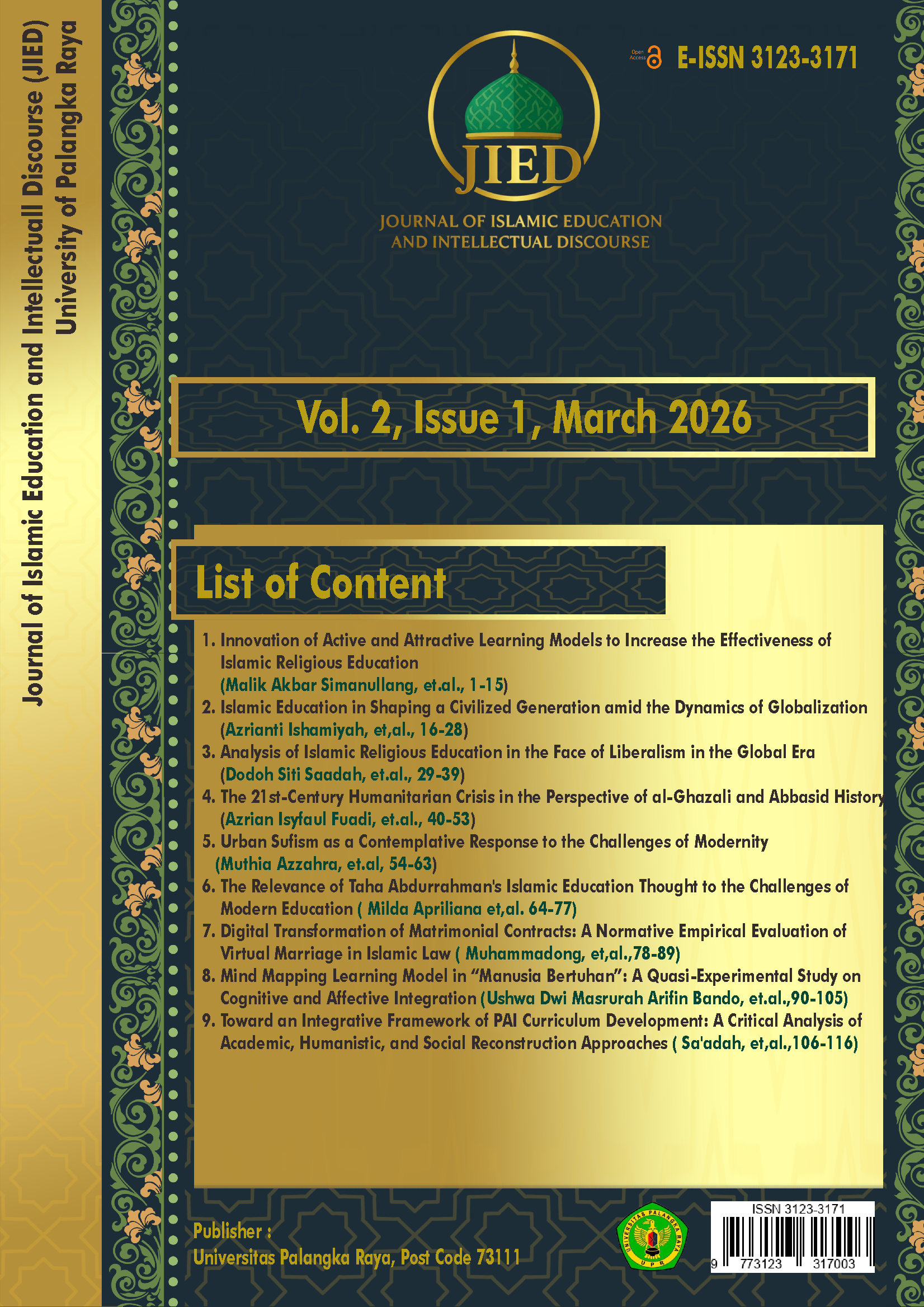
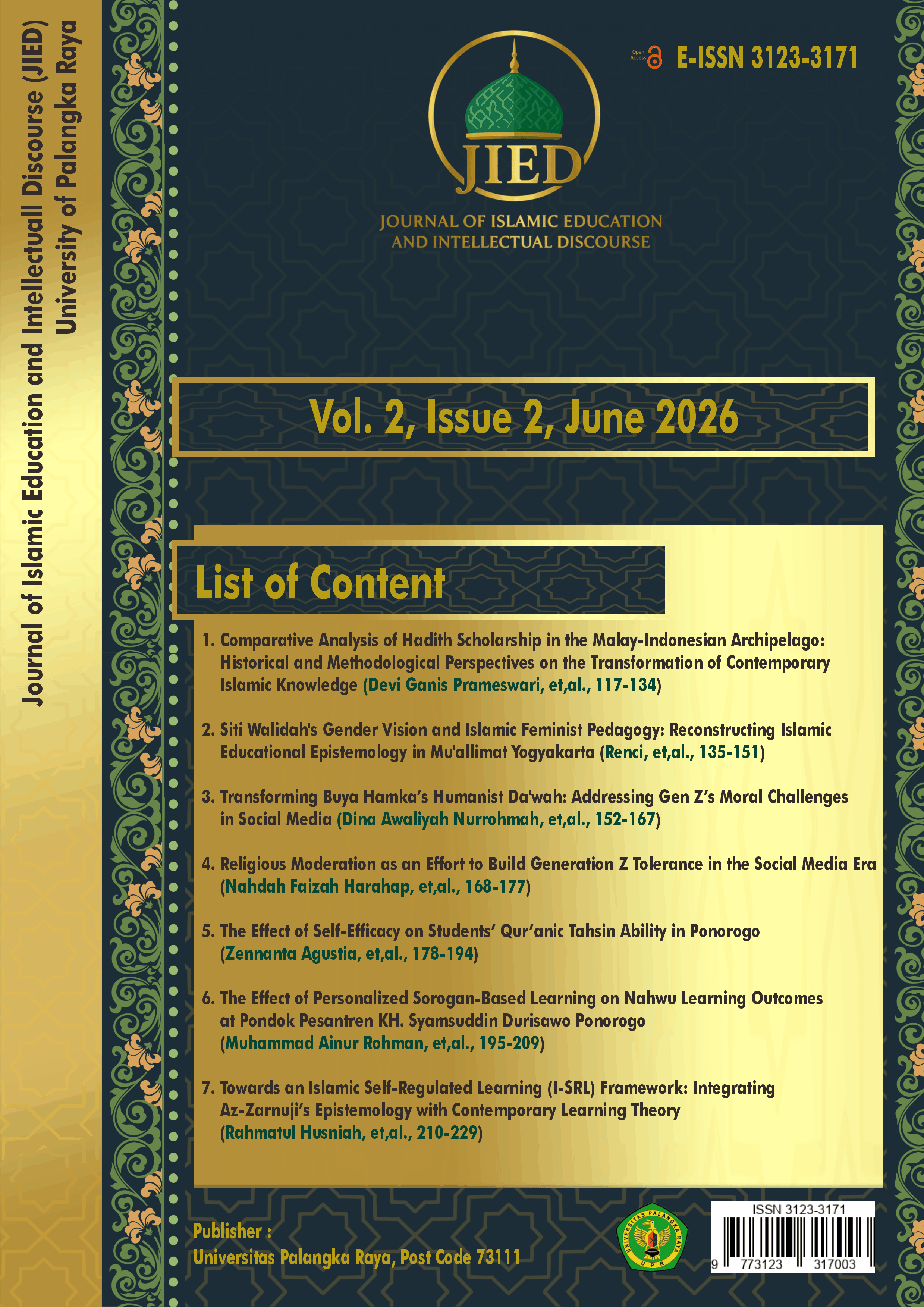
The Journal of Islamic Education and Intellectual Discourse (JIED) Volume 2, Issue 1, March 2026 highlights contemporary discussions on the transformation of Islamic education, intellectual renewal, and the relevance of Islamic values in responding to global social change and technological development. The articles published in this edition demonstrate a strong emphasis on the innovation of Islamic learning models through active, attractive, and mind mapping approaches aimed at strengthening cognitive, affective, and character-based learning outcomes. At the same time, several studies reaffirm the strategic role of Islamic education in shaping a civilized generation capable of responding critically to globalization, liberalism, and modern educational challenges while maintaining ethical and spiritual foundations. This edition also presents broader intellectual reflections through discussions on humanitarian crises from the perspective of al-Ghazali and Abbasid history, as well as the growing relevance of urban Sufism as a contemplative response to modernity and spiritual disorientation in contemporary society. In the field of Islamic law and digital transformation, the study on virtual marriage provides an important contribution to the normative and empirical discourse surrounding the adaptation of Islamic legal practices in the digital era. Overall, this edition reflects JIED’s commitment to promoting interdisciplinary scholarship that integrates Islamic education, intellectual discourse, spirituality, law, and contemporary social issues. The journal continues to serve as an academic platform for strengthening Islamic intellectual traditions while encouraging critical, contextual, and transformative approaches to education and society in the modern world.
Publisher : Faculty of Teacher Training and Education, Universitas Palangka Raya, Central Kalimantan, Indonesia, Postal Code: 73112

This work is licensed under a Creative Commons Attribution-ShareAlike 4.0 International License.
View States Journal of Islamic Education and Intellectual Discourse