













Tentang Jurnal Ini

About Journal

Journal of Islamic Education and Intellectual Discourse (JIED) is a double-blind peer-reviewed journal focuses on publishing high-quality scholarly works that explore the philosophical, pedagogical, legal, and intellectual dimensions of Islamic education. The journal welcomes interdisciplinary research that bridges classical Islamic scholarship and contemporary educational thought. JIED encourages authors to engage in critical discourse that connects Islamic spirituality, ethics, and intellectual tradition with present-day challenges in education, law, and civilization. JIED was established in November 2025 through the Decree of the Dean of the Faculty of Teacher Training and Education No. 6976/UN24.3/DT/2025. JIED maintains strong collaborative partnerships with national and institutional organizations committed to advancing Islamic education, intellectual discourse, and academic excellence such as: ADPISI (Asosiasi Dosen Pendidikan Agama Islam Seluruh Indonesia), PPPAI (Perkumpulan Program Studi Pendidikan Agama Islam Indonesia), AGPAII (Asosiasi Guru Pendidikan Agama Islam Indonesia), AMKI (Asosiasi Masjid Kampus Indonesia), KKG PAI (Kelompok Kerja Guru Pendidikan Agama Islam)

Journal Information

Journal Title Journal of Islamic Education and Intellectual Discourse
Initials JIED
Language English (Preferred); Indonesian; Arab
Management Style Open Access
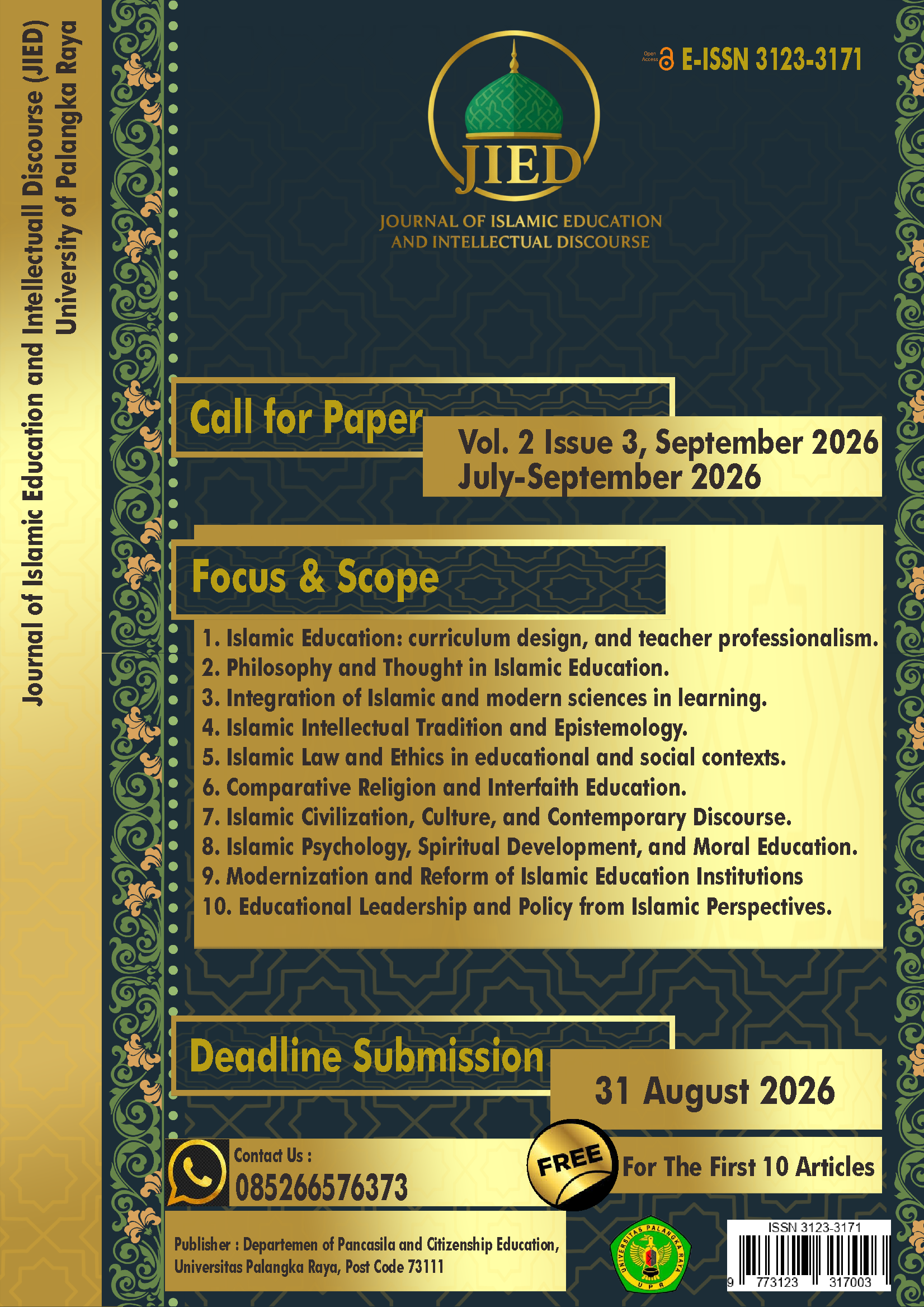
Subject Areas -Islamic education theory and practice
-Curriculum and pedagogy in Islamic institutions
-Integration of religious and scientific knowledge
-Educational leadership and Islamic epistemology
-Intellectual reform and renewal in the Muslim world
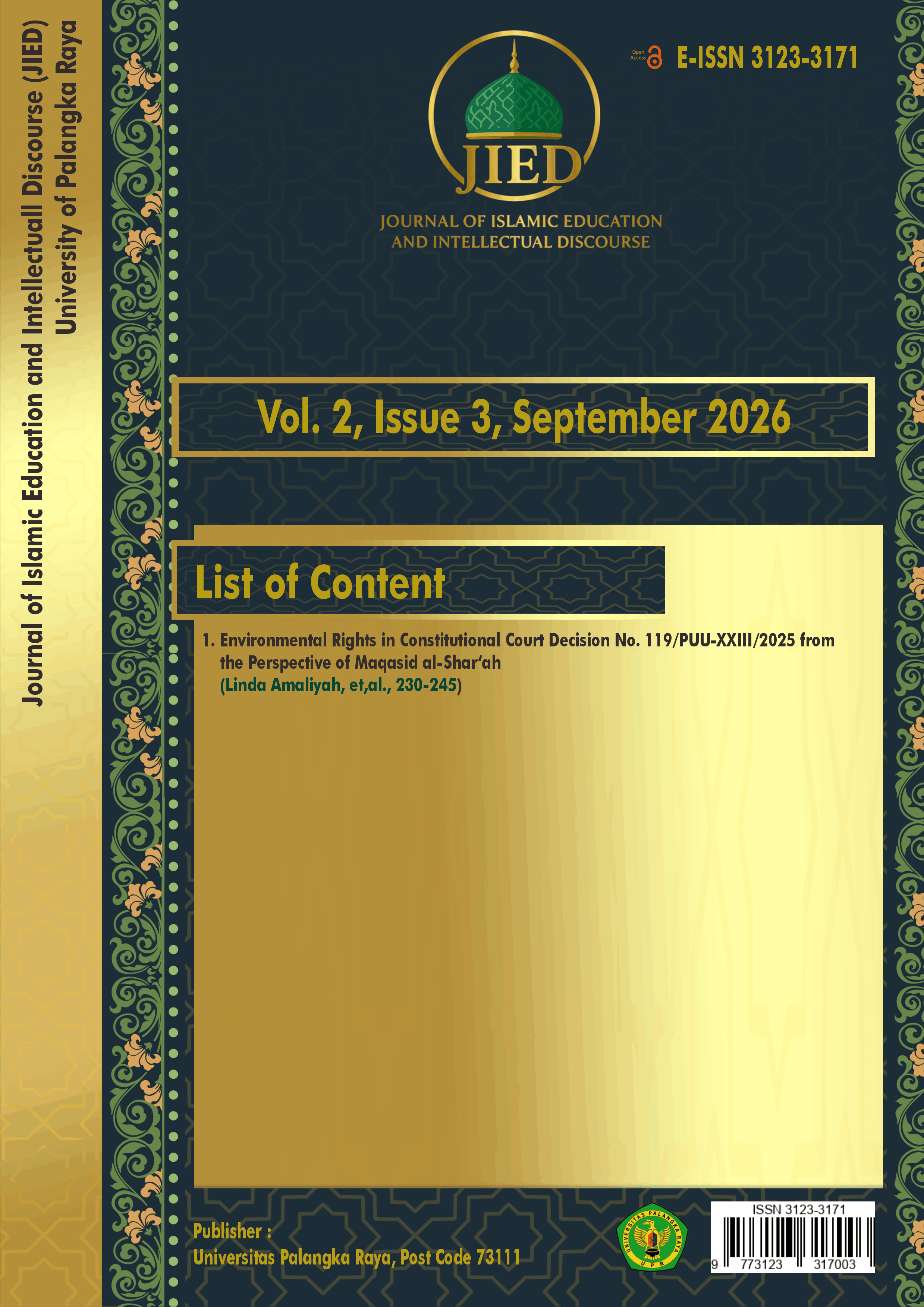
E-ISSN 3123-3171 (Online)
Frequency 4 Issues per year (Maret, Juni, September, December)
DOI Prefix 10.37304/jied
Publisher Faculty of Teacher Training and Education, Palangka Raya University, Central Kalimantan, Indonesia. Post Code 73112.
Indexed Targetted Sinta, DOAJ, Crossref, Garuda, Google Scholar, Dimensions, Base, WorldCat, Road, Scilit, Citeulike, ISJD, OneSearch, Moraref, Academia, OpenAire, Index Copernicus, EBSCO, Academic Resource Index,  Journal Factor, Harvard Library.
Citation Analysis Crossref | Dimensions | Google Scholar
Citation Usage APA 7 Edition, Mendeley
Editor-In-Chief Ahmad Saefulloh (Orcid, Scopus ID, Google Scholar, Sinta ID, Garuda)


Colaboration


Current Targets (Next 6 Months)


National and International Accreditation Targets


Terbitan Terkini

Vol 2 No 01 (2026): March
					Lihat Vol 2 No 01 (2026): March

The Journal of Islamic Education and Intellectual Discourse (JIED) Volume 2, Issue 1, March 2026 highlights contemporary discussions on the transformation of Islamic education, intellectual renewal, and the relevance of Islamic values in responding to global social change and technological development. The articles published in this edition demonstrate a strong emphasis on the innovation of Islamic learning models through active, attractive, and mind mapping approaches aimed at strengthening cognitive, affective, and character-based learning outcomes. At the same time, several studies reaffirm the strategic role of Islamic education in shaping a civilized generation capable of responding critically to globalization, liberalism, and modern educational challenges while maintaining ethical and spiritual foundations. This edition also presents broader intellectual reflections through discussions on humanitarian crises from the perspective of al-Ghazali and Abbasid history, as well as the growing relevance of urban Sufism as a contemplative response to modernity and spiritual disorientation in contemporary society. In the field of Islamic law and digital transformation, the study on virtual marriage provides an important contribution to the normative and empirical discourse surrounding the adaptation of Islamic legal practices in the digital era. Overall, this edition reflects JIED’s commitment to promoting interdisciplinary scholarship that integrates Islamic education, intellectual discourse, spirituality, law, and contemporary social issues. The journal continues to serve as an academic platform for strengthening Islamic intellectual traditions while encouraging critical, contextual, and transformative approaches to education and society in the modern world.

Diterbitkan: 30-01-2026

Articles

Lihat semua terbitan