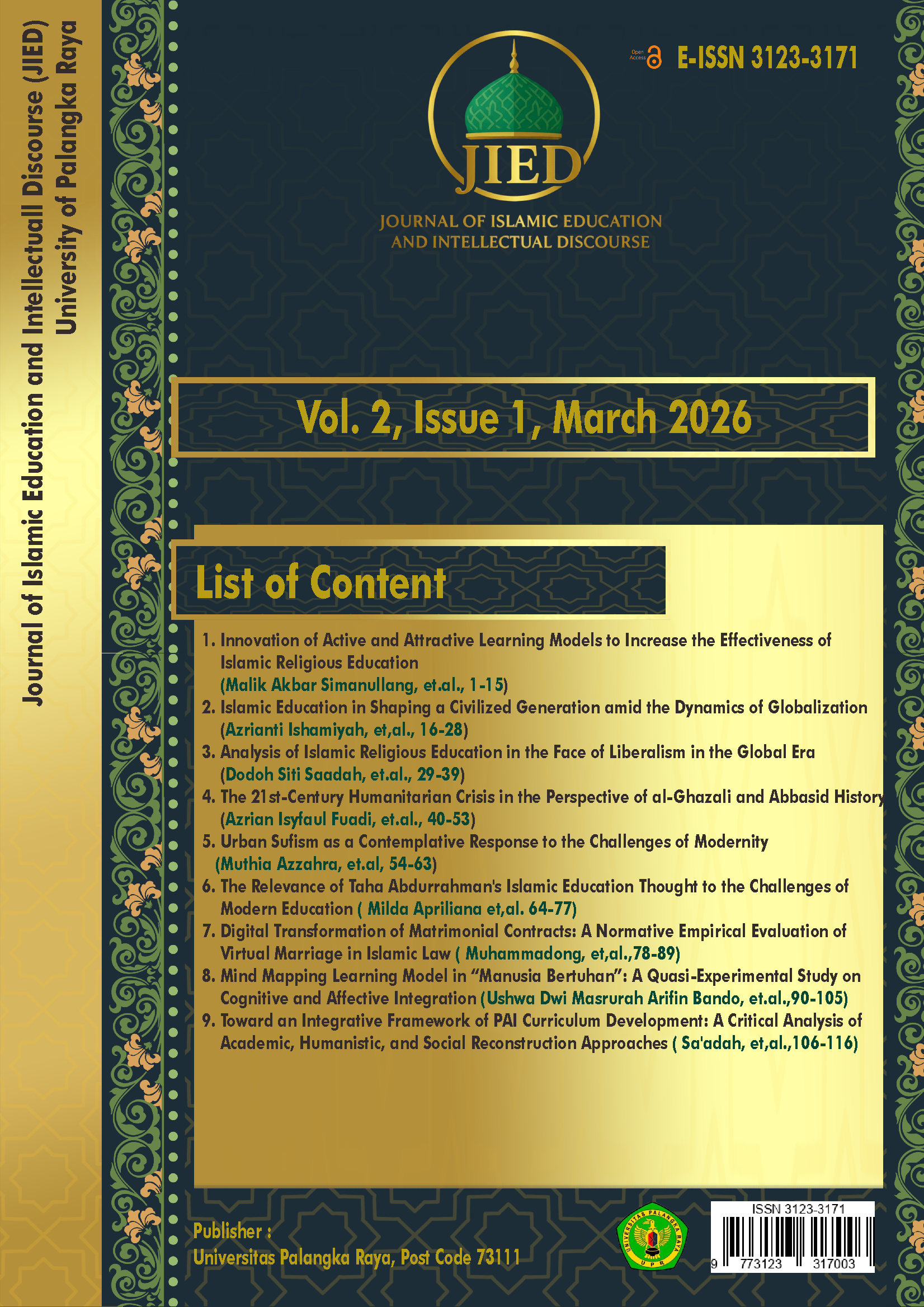
The Relevance of Taha Abdurrahman's Islamic Educational Thought to the Challenges of Modern Education
(Relevansi Pemikiran Pendidikan Islam Taha Abdurrahman terhadap Tantangan Pendidikan Modern)
DOI:
https://doi.org/10.37304/jied.v2i01.24011Keywords:
Islamic Education, Taha Abdurrahman, Ethical Rationality, Moral Education, Modern Educational ChallengesAbstract
Contemporary education is increasingly dominated by instrumental rationality, technocratic management, and efficiency-oriented approaches, which often marginalize ethical, spiritual, and moral dimensions. In Islamic education, this condition creates a tension between normative ideals that emphasize moral and spiritual formation and the uncritical adoption of modern educational paradigms. This study aims to examine the relevance of Taha Abdurrahman’s Islamic educational thought in addressing the challenges of modern education, particularly moral crisis, secularization, and the reduction of education to technical skill transmission. Using a qualitative library research approach, the study analyzes primary works of Taha Abdurrahman and relevant secondary literature on Islamic education, philosophy of education, and modernity. Data were examined through content analysis with a philosophical-critical perspective to identify and synthesize key concepts such as ethical rationality (al-‘aql al-akhlāqī), moral responsibility (amanah), and spiritual consciousness. The findings indicate that Taha Abdurrahman offers a coherent ethical-spiritual framework that critiques instrumental rationality and secularized education while proposing an integrative model that unites knowledge, ethics, and spirituality. His thought highlights education as a process of moral and character formation rather than mere cognitive achievement. The study implies that Islamic education can benefit from reorienting its goals, curriculum, and pedagogical practices toward ethical and spiritual integration. In conclusion, Taha Abdurrahman’s educational philosophy provides a relevant conceptual foundation for renewing Islamic education in responding to modern challenges, while maintaining its moral identity and humanistic orientation, and offers direction for further theoretical and applied research.
Downloads
References
Abbas, N., & Rachman, M. A. (2023). Analysis of Contemporary Islamic Thought (A Critical Study of Harun Nasution's Thought). Publicity Journal, 12(2), 17–30.
Abderrahman, T. (2008). A Global Ethic : Its Scope and Limits (Issue 1). Tabah Foundation.
Abdurrahman, T. (2000). Al-‘Amal al-Dīnī wa Tajdīd al-‘Aql. al-Markaz al- Thaqafi al-arabi. https://www.researchgate.net/publication/365794787_Translation_and_Modernity_Abd_ar-Rahman_Taha’s_Project_of_Renewing_Islamic_Thought/link/676d829e894c5520852b6d9d/download?_tp=eyJjb250ZXh0Ijp7ImZpcnN0UGFnZSI6InB1YmxpY2F0aW9uIiwicGFnZSI6InB1YmxpY2F0aW9uIn
Abdurrahman, T. (2012). Al-Ḥaqq al-‘Arabī fī al-Ikhtilāf al-Falsafī. Arab Cultural Center (al-Markaz al-Thaqāfī al-‘Arabī).
Agusta, I. (2007). Indonesia in the Linkage of Development Culture and Indonesian Culture in the Linkage of Development Culture and Villager Culture. 9(2). https://doi.org/10.17510/wjhi.v9i2.209
Agustin, E. (2025). Digital Transformation in Islamic Education Management: Opportunities and Challenges in the Era of Society 5. 0. pp. 4(06), 850–859. https://media.neliti.com/media/publications/67712-ID-integrasi-pendidikan-islam-nilai-nilai-i.pdf
Al-Raḥmān., T. ʻAbd. (2005). The Spirit of Modernity: The Introduction to the Establishment of Islamic Modernity. In Ṭāhā ʻAbd al-Raḥmān. (al-Ṭabʻah). Arab Cultural Center. https://doi.org/LK - https://worldcat.org/title/63158010
Al-Rahman, T. A. (2000). Suʾāl al-Akhlāq: Musāhamah fī al-Naqd al-Akhlāqī li al-Ḥadāthah al-Gharbiyyah. al-Markaz al-Thaqāfī al-‘Arabī. https://citj.org/index.php/citj/article/download/5469/4597/11809
Ali, F., Bouzoubaa, K., Gelli, F., & Hamzi, B. (2025). Islamic Ethics and AI : An Evaluation of Existing Approaches to AI using Trusteeship Ethics. Philosophy & Technology, 38(3), 1–34. https://doi.org/10.1007/s13347-025-00922-4
APRILIANA, M. (2024). Analysis of Contemporary Islamic Thought (Critical Study of Mohammed Arkoun’s Thought). Integration: Journal Of Social Sciences And Culture, 2(3), 269–277. https://doi.org/10.38142/ijssc.v2i3.228
Azisl, A., Rizqi, A. F., Indah, L. L., & K, N. K. (2025). Challenges and Problems of Contemporary Education in the Islamic Perspective in the Era of Globalization. Morals: Journal of Islamic Education Studies, 2(2), 224–240. file:///C:/Users/HP/Downloads/MORAL+-+VOLUME+2+NOMOR+2+JUNI+2025+hal+224-240 (2).pdf
Biesta, G. (2008). GOOD EDUCATION IN AN AGE OF MEASUREMENT: ON THE NEED TO RECONNECT WITH THE QUESTION OF PURPOSE IN EDUCATION. For Educational Assessment, Evaluation and Accountabilit, 1–14. https://www.researchgate.net/publication/41529875_Good_Education_in_an_Age_of_Measurement_On_the_Need_to_Reconnect_with_the_Question_of_Purpose_in_Education/link/5970fdb74585153016391e07/download?_tp=eyJjb250ZXh0Ijp7ImZpcnN0UGFnZSI6InB1YmxpY2F0aW9uIiwicGFnZSI6InB1YmxpY2F0aW9uIn19
Elfalih, T. (2025). Ethics Unbound : Islam and the Philosophy of Taha Abdurrahman. IJSRIS, 4(5), 117–123. https://www.ijsrisjournal.com/index.php/ojsfiles/article/view/459/333
Fahmi, I. R., & Rohman, M. A. A. (2021). Non-Dichotomy of Knowledge: Integration-Interconnection in Islamic Education. AL-MIKRAJ : Journal of Islamic Studies and Humanities (e-ISSN: 2745-4584), 1(2), 46–60. https://doi.org/10.37680/almikraj.v1i2.750
Gustanto, E. S., Asmuni, & Lubis, R. R. (2024). Religious Ethical Concepts with the Sharia Maqashid Approach Thaha Abd Al-Rahman Perspective. Bustanul Fuqaha : Journal of Islamic Law, 5(1), 212–224. https://doi.org/10.36701/bustanul.v5i1.1341.PENDAHULUAN
Habermas, J. (1987). The Theory of Communivative Action (2nd ed.). Polity Press. https://ia800507.us.archive.org/15/items/jurgen-habermas-religion-and-rationality-essays-on-reason-god-and-modernity/Jurgen Habermas - The Theory of Communicative Action%2C Vol. Two - Polity.pdf
Hajriana, H. (2018). The Relevance of Mohammed Arkoun's Thought in Islamic Education in Indonesia. SYAMIL: Journal of Islamic Education, 6(1), 23–38. https://doi.org/10.21093/sy.v6i1.988
HK., M. R. (2020). Read taha abdurrahman's thoughts on Islamic political ethics. In POLITICS: Journal of Islamic Politics (Vol. 3, Issue 2). https://media.neliti.com/media/publications/521693-none-e73e01a2.pdf
Ikhwan, A. (2003). INTEGRATION OF ISLAMIC EDUCATION (Islamic Values in Learning). Athleticism, 02(2), 179–194. https://media.neliti.com/media/publications/67712-ID-integrasi-pendidikan-islam-nilai-nilai-i.pdf
Malinova, M. (2021). “translation and modernity: ῾ abd ar-raḥmān ṭaha’s project of renewing islamic thought” m. March 2019, 163–172. https://www.researchgate.net/publication/365794787_Translation_and_Modernity_Abd_ar-Rahman_Taha’s_Project_of_Renewing_Islamic_Thought/link/676d829e894c5520852b6d9d/download?_tp=eyJjb250ZXh0Ijp7ImZpcnN0UGFnZSI6InB1YmxpY2F0aW9uIiwicGFnZSI6InB1YmxpY2F0aW9uIn
Muntashir, M. S., & Attamimi, F. (2025). The Concept of Reason in Al-Ghazali's Thought and Its Relevance to the Ethics of Artificial Intelligence in the Era of Society 5 . 0. KIIIES 5.0, 1(1), 325–330. https://jurnal.uindatokarama.ac.id/index.php/kiiies50/article/download/4211/2075
Muslih, M. (2012). Contemporary Islamic Thought, Between Modes of Thought and Reading Models. Tsaqafah, 8(2), 347. https://doi.org/10.21111/tsaqafah.v8i2.28
Nasr, S. H. (2002). The Heart of Islam Enduring Values for Humanity Introduction to Islam.
Rabi'ah. (2023). THEORIES OF ISLAMIC EDUCATION IN DOCTRINAL, PHILOSOPHICAL, SOCIOLOGICAL NORMATIVE APPROACHES,. TARBAWI : Journal of Education and Religion, 11(01), 1–17. https://journal.stitdarulhijrahmtp.ac.id/index.php/Tarbawi/article/download/70/pdf
Rofi, M. (2025). Journal of Madrasah Education. Journal of Madrasah Education, 10(1), 1–6. https://ejournal.uin-suka.ac.id/tarbiyah/JPM/article/download/12126/4268/41720
Rohmanu, A., & Rofiah, K. (2023). Ṭāhā ‘ Abd al-Raḥmān ’ s Philosophical Contribution to Theorize Ethical Maqāṣid. Al -Ahkam : Jurnal Pemikiran Hukum Islam, 33(2), 185–206. https://journal.walisongo.ac.id/index.php/ahkam/article/download/17527/5092/54081
Rusyadi, A., Azis, A., Amri, M., Ramadhanu, A., & Setyaningsih, R. (2025). Modern Western Epistimology. Religion and Philosophy Research, 4(2), 257–266. https://www.ijsrisjournal.com/index.php/ojsfiles/article/view/459/333
Somad, A., Syafe'i, M., Abdussalam, A., Syahidin, Anwar, S., Fakhruddin, A., & Surahman, C. (2016). Islamic Education Faces Global Challenges (First). Alqaprint Jatinagor.
Suyani, E., Lubis, L., Dhaarmawangsa, U., Islam, U., Sumatra, N., & Medan, U. (2025). Issues of Secularization in Islamic Education. Continuous Education: Journal of Science and Research, 6(2), 347–359. https://pusdikra-publishing.com/index.php/josr/article/download/2746/2139/8141
Syafiuddin, A., & Islam, P. K. (2018). THE INFLUENCE OF POWER OVER KNOWLEDGE (Understanding Michel Foucault's Theory of Power Relations) Arif Syafiuddin Fan of Islamic Studies, Mojokerto. Reflection, 18(2), 141–155. doi: https://doi.org/10.14421/ref.v18i2.1863
Syaifullah, R. (2021). The Relevance of Kh's Thought. Abdurrahman Wahid On Islamic Education in the Modern Era. Nusantara: Indonesian Journal of Education, 1(1), 57–76. https://journal.rumahindonesia.org/index.php/njpi/article/view/29#google_vignette
Viersen, H. (2023). Reconceptualization of the Authenticity – Modernity Paradigm. Religions, 14(2), 2–16. https://www.mdpi.com/2077-1444/14/2/225/notes
Downloads
Published
How to Cite
Issue
Section
License
Copyright (c) 2026 Milda Apriliana

This work is licensed under a Creative Commons Attribution-ShareAlike 4.0 International License.
The author retains full copyright over his/her work. The article is licensed under: Creative Commons Attribution-ShareAlike 4.0 International (CC BY-SA 4.0). This license permits others to copy, distribute, display, and create derivative works, provided they acknowledge the author(s) and the source of the original publication.