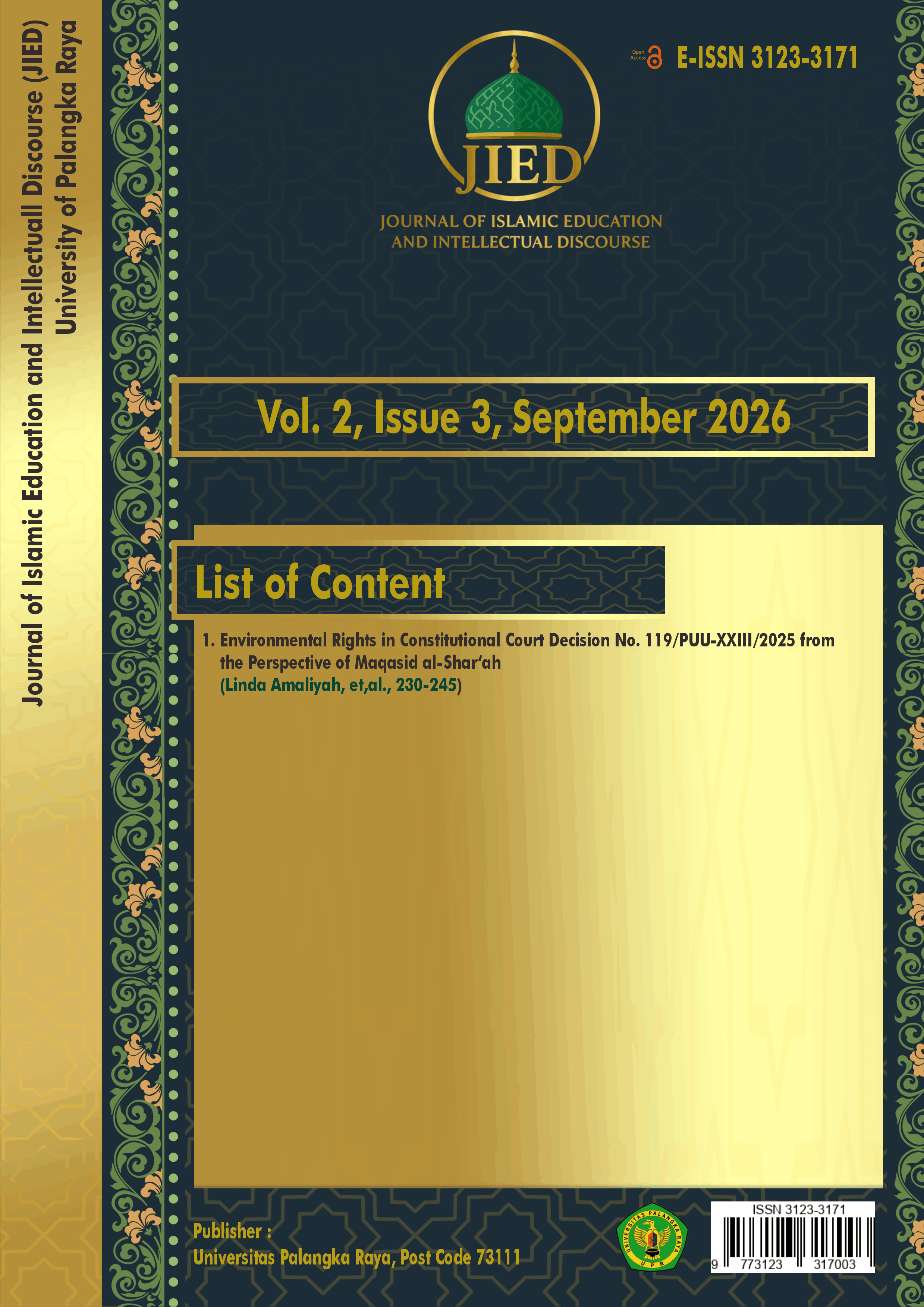
Vol. 2 No. 3 (2026): September

					View Vol. 2 No. 3 (2026): September

Journal of Islamic Education and Intellectual Discourse (JIED) Volume 2, Issue 3, September 2026 presents a range of scholarly studies that reflect the journal’s commitment to advancing critical inquiry into Islamic education, Islamic intellectual tradition, Islamic law and ethics, and contemporary thought through integrative and interdisciplinary perspectives. This issue brings together studies that examine how Islamic knowledge, values, and intellectual traditions engage with contemporary educational, institutional, legal, and social developments. The article A Data-Informed Conceptual Framework for the Continuous Development of Multicultural Islamic Education Teaching Materials directly contributes to the discourse on Islamic education by developing a conceptual approach to teaching-material development that responds to the complexity of multicultural educational contexts. The study From Policy to Institutional Transformation: Curriculum Integration and Governance Reform under Law No. 18 of 2019 in an Indonesian Islamic Boarding School extends this discussion to the institutional dimension of Islamic education by examining how curriculum integration and governance reform shape the transformation of Islamic educational institutions in response to contemporary policy developments. Meanwhile, Environmental Rights in Constitutional Court Decision No. 119/PUU-XXIII/2025 from the Perspective of Maqāṣid al-Sharī‘ah demonstrates the relevance of Islamic intellectual and legal traditions to contemporary public issues by bringing maqāṣid al-sharī‘ah into dialogue with constitutional law, environmental rights, and public welfare. Similarly, The Evolution of Wadi’ah Contracts in Islamic Banking: Bridging Traditional Fiqh and Modern Product Along with Empirical Case Analysis illustrates the dynamic interaction between classical fiqh and contemporary economic practice, showing how established Islamic legal concepts are interpreted and applied within modern Islamic financial products. Taken together, these studies demonstrate the intellectual coherence and interdisciplinary breadth of JIED, particularly in examining how Islamic educational thought, ethical and legal principles, and classical intellectual traditions can engage critically with contemporary challenges. Through these contributions, the issue reinforces JIED’s role as a scholarly platform for connecting classical Islamic scholarship with contemporary educational and intellectual paradigms, while supporting the continued development of Islamic thought, pedagogy, institutional practice, law, and civilization grounded in the ethical, spiritual, and intellectual values of Islam.

Published: 2026-08-24