














Submit Manuscript And Contact
Download Template Article
Governing Body & Contact
Editorial Policies
Submission
Additional Information
Reference Manager
Plagiarism Cheker
Partner Collaboration
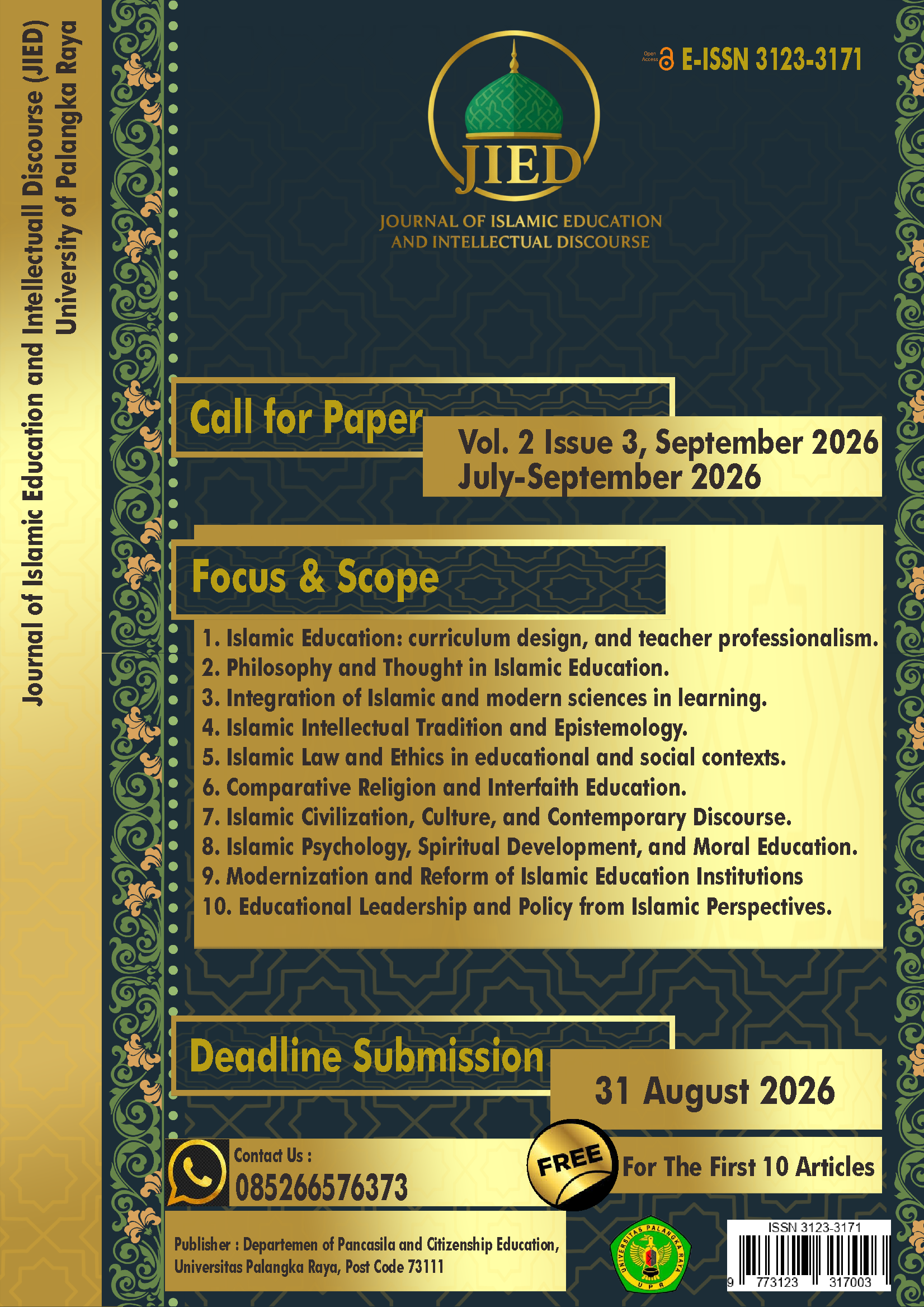
Journal Of Islamic Education And Intellectual Discourse (JIED) is a double-blind peer-reviewed journal focuses on publishing high-quality scholarly works that explore the philosophical, pedagogical, legal, and intellectual dimensions of Islamic education. The journal welcomes interdisciplinary research that bridges classical Islamic scholarship and contemporary educational thought. JIED encourages authors to engage in critical discourse that connects Islamic spirituality, ethics, and intellectual tradition with present-day challenges in education, law, and civilization. JIED was established in November 2025 through the Decree of the Dean of the Faculty of Teacher Training and Education No. 6976/UN24.3/DT/2025. JIED maintains strong collaborative partnerships with national and institutional organizations committed to advancing Islamic education, intellectual discourse, and academic excellence such as: ADPISI (Asosiasi Dosen Pendidikan Agama Islam Seluruh Indonesia), PPPAI (Perkumpulan Program Studi Pendidikan Agama Islam Indonesia), AGPAII (Asosiasi Guru Pendidikan Agama Islam Indonesia), AMKI (Asosiasi Masjid Kampus Indonesia), KKG PAI (Kelompok Kerja Guru Pendidikan Agama Islam)
| Journal Title | Journal Of Islamic Education And Intellectual Discourse |
| Initials | JIED |
| Language | English (Preferred); Indonesian; Arab |
| Management Style | Open Access |
| Subject Areas | 1)Islamic education theory and practice 2)Curriculum and pedagogy in Islamic institutions 3)Integration of religious and scientific knowledge 4)Educational leadership and Islamic epistemology 5)Intellectual reform and renewal in the Muslim world |
| ISSN | Online : (On Process) |
| Frequency | 4 Issues per year (Maret, Juni, September, December) |
| DOI Prefix | 10.37304/jied |
| Publisher | Department of Pancasila and Citizenship Education, Faculty of Teacher Training and Education, Palangka Raya University, Central Kalimantan, Indonesia. Post Code 73112. |
| Indexed Targetted | Sinta, DOAJ, Garuda, Google Scholar, Crossref, Dimensions, Base, WorldCat, Road, Scilit, OneSearch, Moraref, Academia, OpenAire, Index Copernicus, EBSCO, Academic Resource Index, Citeulike, ISJD, Journal Factor, Harvard Library. |
| Citation Analysis | Crossref | Dimensions | Google Scholar |
| Citation Usage | APA 7 Edition, Mendeley |
| Editor-In-Chief | Ahmad Saefulloh (Orcid, Scopus ID, Google Scholar, Sinta ID, Garuda) |
Colaboration
![]() |
![]() |
![]() |
![]() |
Current Targets (Next 6 Months)
![]() |
![]() |
![]() |
![]() |
|
|
![]() |
![]() |
![]() |
![]() |
![]() |
![]() |
![]() |
![]() |
![]() |
![]() |
![]() |
|
National and International Accreditation Targets |
|||
|
|
![]() |
![]() |
![]() |
|
|
![]() |
![]() |
![]() |
|
|
|
|
|
|
|
|
||
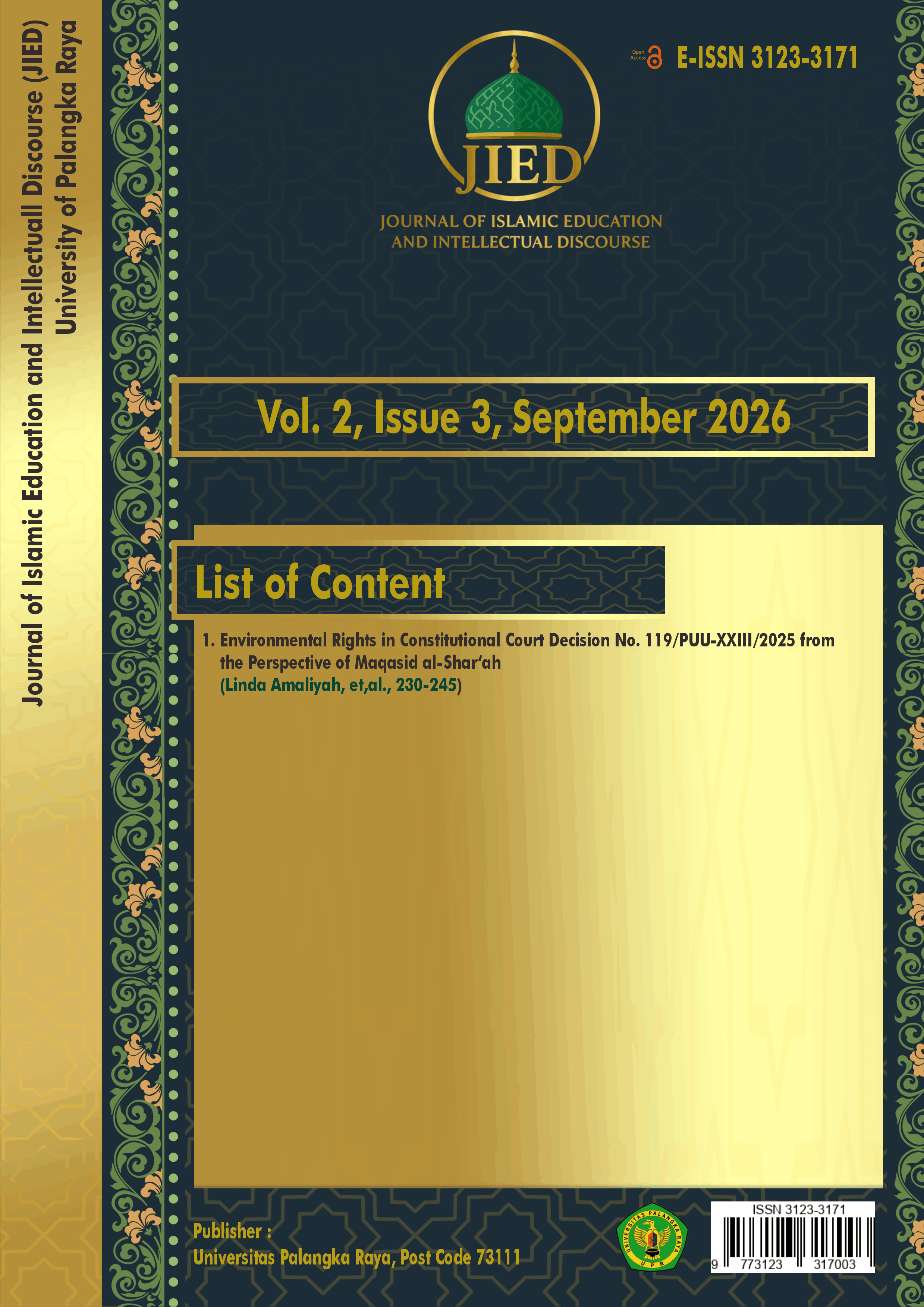
The Journal of Islamic Education and Intellectual Discourse (JIED) Volume 1, Issue 2, December 2025 highlights a strong emphasis on strengthening Islamic education, advancing ethical and spiritual values, and reaffirming the relevance of the Islamic intellectual tradition within contemporary contexts. The articles featured in this edition demonstrate how digital religious discourse can shape global humanitarian awareness, how foundational principles of Islamic commercial law—such as the concept of riba—remain significant in modern market practices, and how Qur’anic values and innovative pedagogical approaches are applied to reinforce students’ character formation in the Society 5.0 era. Through the implementation of the case method, Islamic education is shown to be increasingly adaptive in promoting critical thinking and problem-solving skills, while innovations in active and engaging learning models underscore the need to transform teaching methods to become more effective and responsive to current educational demands. Overall, this edition reflects JIED’s commitment to presenting scholarly research that bridges classical Islamic scholarship with modern paradigms and supports the renewal of Islamic thought grounded in ethical, spiritual, and intellectual values. It further affirms JIED’s role as an academic platform that facilitates intellectual dialogue, enriches Islamic educational discourse, and strengthens the contribution of Islamic thought in addressing global challenges.
Publisher : Department of Pancasila and Citizenship Education, Faculty of Teacher Training and Education, Universitas Palangka Raya, Central Kalimantan, Indonesia, Postal Code: 73112

This work is licensed under a Creative Commons Attribution-ShareAlike 4.0 International License.
View States Journal of Islamic Education and Intellectual Discourse