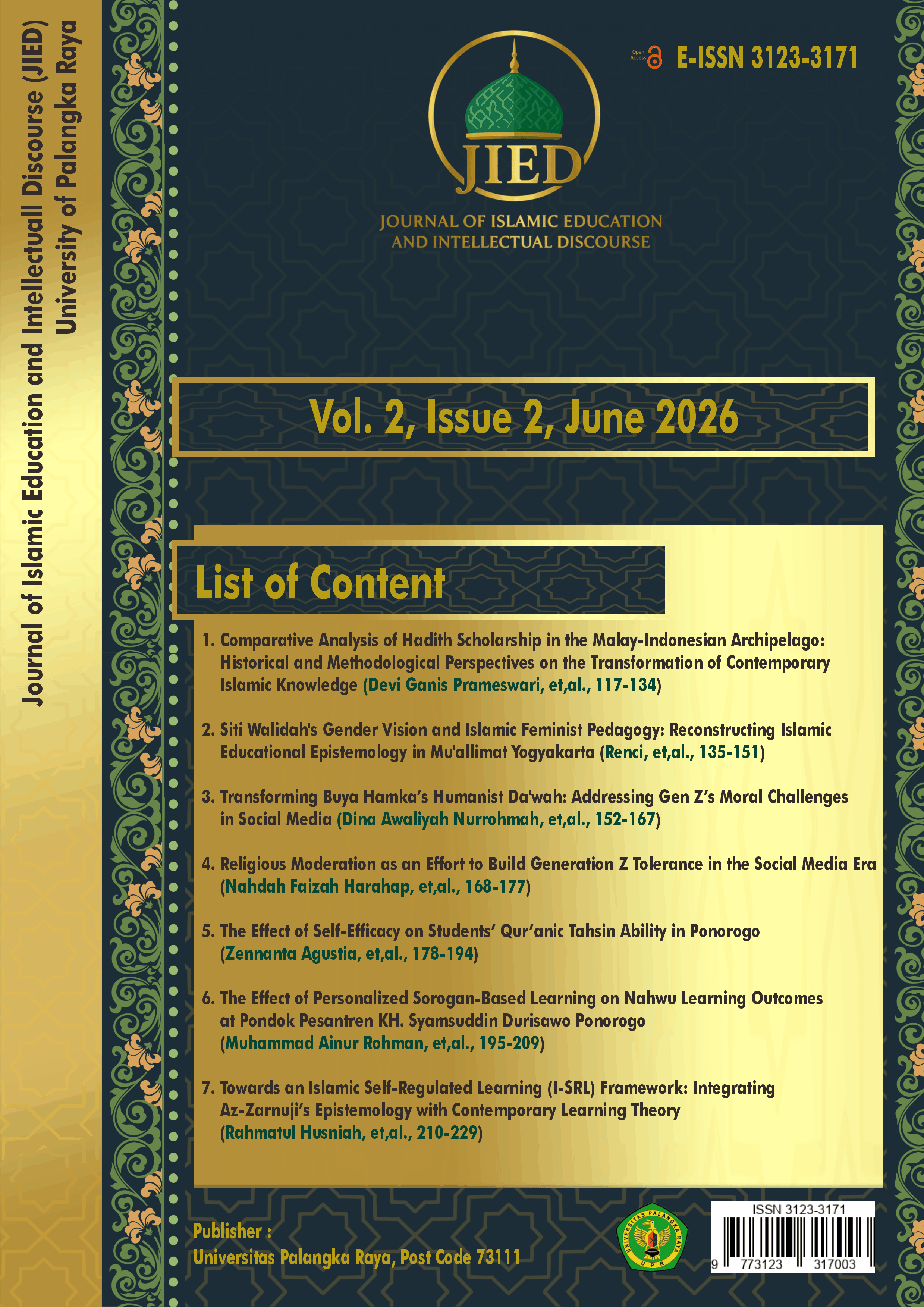
The Effect of Self-Efficacy on Students’ Qur’anic Tahsin Ability in Ponorogo
(Efikasi Diri dan Pembelajaran Tahsin Al-Qur’an dalam Pendidikan Islam Berbasis Sekolah)
DOI:
https://doi.org/10.37304/jied.v2i02.25991Keywords:
Self-efficacy, Qur’anic tahsin, Islamic education, junior secondary students, simple linear regressionAbstract
Qur’anic tahsin learning requires accurate articulation, consistent tajwid application, reading fluency, and students’ readiness to receive corrective feedback. This study examined the effect of self-efficacy on students’ Qur’anic tahsin ability in Ponorogo, a regency where religious-based education in basic education is formally supported by Peraturan Bupati Ponorogo No. 37 of 2022. A quantitative associative design was applied to 216 junior secondary students. Self-efficacy was measured using a 20-item Likert questionnaire, while tahsin ability was obtained from school-documented tahsin assessment scores. Data were analyzed using IBM SPSS through validity testing, reliability testing, descriptive statistics, residual diagnostics, linearity testing, and simple linear regression. The self-efficacy instrument was valid, with item-total correlations ranging from .593 to .712, and reliable, with Cronbach’s alpha of .931. The regression model was statistically significant, F(1, 214) = 83.817, p < .001. Self-efficacy positively predicted Qur’anic tahsin ability, B = .258, SE = .028, β = .531, t = 9.155, p < .001. The model explained 28.1% of the variance in tahsin ability. These findings indicate that self-efficacy is a meaningful psychological factor in tahsin learning and should be considered in school-based Qur’anic education programs.
Downloads
References
Al-Attas, S. M. N. (2023). The concept of education in Islam: A framework for an Islamic philosophy of education (3rd ed.). Qadeem Press.
Annuri, A. (2016). Panduan tahsin tilawah Al-Qur’an dan ilmu tajwid. Pustaka Al-Kautsar.
Bandura, A. (1997). Self-efficacy: The exercise of control. W. H. Freeman.
Budiyanti, N., Komariah, K. S., Hermawan, W., Jenuri, J., & Hyangsewu, P. (2024). Impact of the Ulul Ilm model on six domains of student learning outcomes in Islamic Religious Education. Jurnal Pendidikan Islam, 10(1). https://doi.org/10.15575/jpi.v10i1.33225
Creswell, J. W., & Creswell, J. D. (2018). Research design: Qualitative, quantitative, and mixed methods approaches (5th ed.). SAGE Publications.
Dahuri, D., & Wantini, W. (2023). Learning Islamic Religious Education based on ta’dib perspective of Islamic education psychology at Muhammadiyah Pakel Elementary School. Journal of Islamic Education and Ethics, 1(2), 95–108. https://doi.org/10.18196/jiee.v1i2.9
Felsenthal, I., & Agbaria, A. (2023). How to read the Quran in religious Islamic education: What educators can learn from the work of Mohammed Arkoun. Religions, 14(1), 129. https://doi.org/10.3390/rel14010129
Field, A. (2018). Discovering statistics using IBM SPSS statistics (5th ed.). SAGE Publications.
Fitriani, D. I., & Hayati, F. (2020). Penerapan metode tahsin untuk meningkatkan kemampuan membaca Al-Qur’an siswa sekolah menengah atas. Jurnal Pendidikan Islam Indonesia, 5(1). https://doi.org/10.35316/jpii.v5i1.227
Gade, A. M. (2004). Perfection makes practice: Learning, emotion, and the recited Qur’an in Indonesia. University of Hawai’i Press.
Honicke, T., & Broadbent, J. (2016). The influence of academic self-efficacy on academic performance: A systematic review. Educational Research Review, 17, 63–84. https://doi.org/10.1016/j.edurev.2015.11.002
Ibn al-Jazari, M. (2006). Al-Muqaddimah al-Jazariyyah fi ma yajibu “ala qari” al-Qur’an an ya’lamah. Dar al-Minhaj.
JDIH BPK RI. (2022). Peraturan Bupati Kabupaten Ponorogo Nomor 37 Tahun 2022 tentang Penyelenggaraan Pendidikan Berbasis Keagamaan pada Pendidikan Dasar di Kabupaten Ponorogo. https://peraturan.bpk.go.id/Details/218510/perbup-kab-ponorogo-no-37-tahun-2022
Lahmar, F. (2020). Islamic education: An Islamic “wisdom-based cultural environment” in a western context. Religions, 11(8), 409. https://doi.org/10.3390/rel11080409
Nugraha, T. C., Rahim, E.-S. E. A. A., & Lukman, F. (2024). Integrating problem-based and flipped learning in Islamic Religious Education: A pathway to achieving sustainable development goals. Jurnal Pendidikan Islam, 10(1). https://doi.org/https://doi.org/10.15575/jpi.v10i1.35204
Pajares, F. (1996). Self-efficacy beliefs in academic settings. Review of Educational Research, 66(4), 543–578. https://doi.org/10.3102/00346543066004543
Pallant, J. (2020). SPSS survival manual: A step by step guide to data analysis using IBM SPSS (7th ed.). Routledge.
Parhan, M., Syahidin, S., M., A. S., Abdulah, M., & Nugraha, R. H. (2024). Developing a contextual learning model in Islamic education to improve applicable knowledge and foster knowledge-based virtues. Jurnal Pendidikan Islam, 10(1). https://doi.org/10.15575/jpi.v10i1.35205
Prasetia, S. A. (2024). Reconsidering Islamic education pedagogical approach within Islamic studies. Jurnal Penelitian Pendidikan Islam, 12(1), 19–40. https://doi.org/10.36667/jppi.v11i1.1568
Sa’adah, S., Tobroni, T., & Faridi, F. (2026). Toward an Integrative Framework of PAI Curriculum Development: A Critical Analysis of Academic, Humanistic, and Social Reconstruction Approaches. Journal of Islamic Education and Intellectual Discourse, 2(1), 106–116. https://doi.org/10.37304/jied.v2i01.24629
Sada, H. J., Fadila, A., Handayani, L., & Putra, R. W. Y. (2025). Development and validation of contemporary Qur’anic teaching materials: An ADDIE model approach to enhancing student engagement and learning outcomes. Al-Tadzkiyyah: Jurnal Pendidikan Islam, 16(2). https://doi.org/10.24042/atjpi.v16i2.28614
Sahin, A. (2013). New directions in Islamic education: Pedagogy and identity formation. Kube Publishing.
Schunk, D. H., & DiBenedetto, M. K. (2020). Motivation and social cognitive theory. Contemporary Educational Psychology, 60, 101832. https://doi.org/10.1016/j.cedpsych.2019.101832
Talsma, K., Schüz, B., Schwarzer, R., & Norris, K. (2019). I believe, therefore I achieve (and vice versa): A meta-analytic cross-lagged panel analysis of self-efficacy and academic performance. Learning and Individual Differences, 75, 101768. https://doi.org/10.1016/j.lindif.2019.101768
Zimmerman, B. J. (2000). Self-efficacy: An essential motive to learn. Contemporary Educational Psychology, 25(1), 82–91. https://doi.org/10.1006/ceps.1999.1016
Downloads
Published
How to Cite
Issue
Section
License
Copyright (c) 2026 Zennanta Agustia, Retno Widyaningrum

This work is licensed under a Creative Commons Attribution-ShareAlike 4.0 International License.
The author retains full copyright over his/her work. The article is licensed under: Creative Commons Attribution-ShareAlike 4.0 International (CC BY-SA 4.0). This license permits others to copy, distribute, display, and create derivative works, provided they acknowledge the author(s) and the source of the original publication.