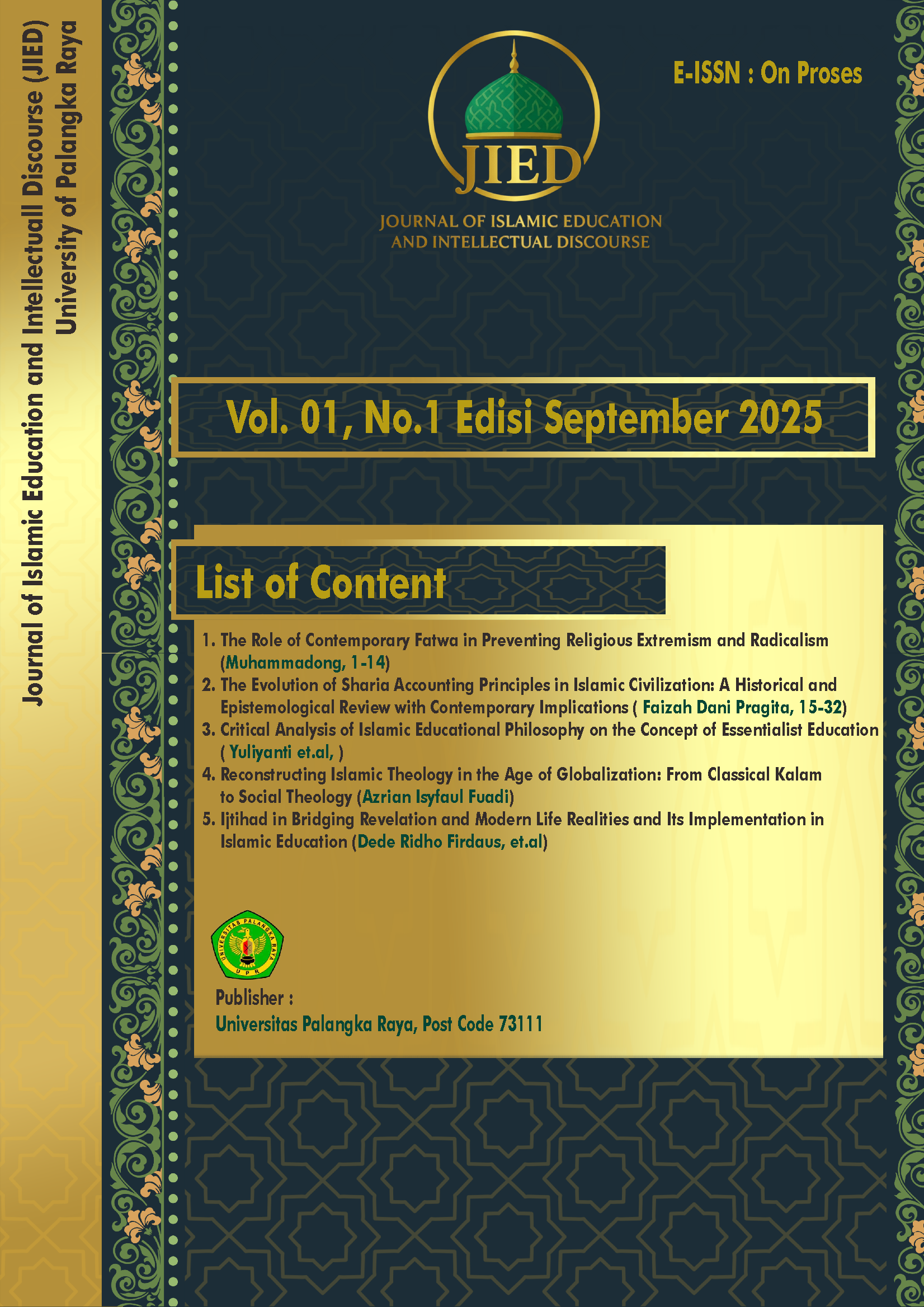
The Role of Contemporary Fatwa in Preventing Religious Extremism and Radicalism
DOI:
https://doi.org/10.37304/jied.v1i1.23328Keywords:
Dipilih:Fatwas, Religious, Extremism, RadicalismHapus Fatwas, Religious, Extremism, RadicalismAbstract
This research aims to analyse the function of contemporary fatwas in mitigating extremism and radicalism, providing insights into their efficacy within the current social and cultural milieu. The goal of this study is to help come up with innovative ways to deal with these threats. The growth of radicalism and religious fanaticism, especially in Muslim populations, is a menace to the whole world. Misreading religious scriptures and spreading radical ideas frequently lead to bloodshed, which makes things less peaceful. Fatwas, which are religious rulings made by Islamic experts, are very important for dealing with these problems. This qualitative study examines the function of fatwas in mitigating extremism and radicalism. It looks at fatwas given by well-known scholars and institutions in reaction to extremist ideology. It focuses on how these fatwas make it clear what the true understanding of Islam is and discourage radical beliefs. The results show how important fatwas are for spreading moderate, peaceful views of Islam and how important religious leaders are for leading communities towards tolerance and living together. The study indicates that fatwas can effectively inhibit the proliferation of extremism, contingent upon their issuance by reputable, competent scholars who prioritise peace in their interpretations.
Tujuan dari penelitian ini adalah untuk menganalisis fungsi fatwa kontemporer dalam meredam ekstremisme dan radikalisasi, memberikan wawasan mengenai efektivitasnya dalam konteks sosial dan budaya saat ini. Penelitian ini bertujuan untuk membantu mencari cara inovatif dalam menangani ancaman-ancaman ini. Pertumbuhan radikalisasi dan fanatisme agama, terutama di kalangan populasi Muslim, menjadi ancaman bagi seluruh dunia. Penafsiran yang keliru terhadap teks-teks agama dan penyebaran ide-ide radikal sering kali berujung pada pertumpahan darah, yang mengurangi kedamaian. Fatwa, yaitu keputusan-keputusan agama yang dikeluarkan oleh ahli agama Islam, sangat penting dalam menangani masalah-masalah ini. Penelitian kualitatif ini mengkaji fungsi fatwa dalam meredam ekstremisme dan radikalisasi. Penelitian ini memeriksa fatwa-fatwa yang dikeluarkan oleh ulama dan lembaga terkemuka sebagai respons terhadap ideologi ekstremis. Fokusnya adalah bagaimana fatwa-fatwa tersebut menjelaskan pemahaman yang benar tentang Islam dan mencegah keyakinan radikal. Hasil penelitian menunjukkan betapa pentingnya fatwa dalam menyebarkan pandangan moderat dan damai tentang Islam serta peran penting pemimpin agama dalam membimbing komunitas menuju toleransi dan kehidupan bersama. Penelitian ini menunjukkan bahwa fatwa dapat secara efektif menghambat penyebaran ekstremisme, tergantung pada penerbitannya oleh ulama yang memiliki reputasi dan kompetensi, yang mengutamakan perdamaian dalam penafsirannya
Downloads
References
Amrin, A., & Amirulah, A. (2022). Contemporary legal istimbat: Study on the theory of changes in fatwa according to Yusuf Qardhawi. MIZAN: Journal of Islamic Law, 10(1), 89 108. https://doi.org/10.32832/mizan.v10i1.20331
Aswan, & Ashufah, A. H. (2023). Fatwa Authority of the Indonesian Ulema Council on the Formation of Religious Regulations in Indonesia: Siyāsah Dustūriyyah Perspective. PAREWA SARAQ: Journal of Islamic Law and Fatwa Review, 2(1), 50 58. https://doi.org/10.64016/parewasaraq.v2i1.18
Asa’ari, A., Nurdiansyah, R., Mursal, M., & Witro, D. (2022). Religious radicalism prevention model in Ma’had al Jami’ah at State Islamic Universities. Nadwa: Jurnal Pendidikan Islam, 16(1), 1 17. https://doi.org/10.21580/nw.2022.16.1.13871
__________ (2023). Actualization of religious moderation in Islamic fatwas in mainstream online media in Indonesia. Jurnal Penelitian, 20(1), 25 40. https://doi.org/10.28918/jupe.v20i1.1096
Dharta, F. Y. S., Anggara, T., Hariyanto, R., Fajar, & Sianturi, H. R. (2025). MUI’s fatwa on inter faith greetings and religious tolerance: Can Indonesia find a middle ground? Frontiers in Communication, 10. https://doi.org/10.3389/fcomm.2025.1537568
Ellefsen, R. (2024). Everyday prevention of radicalization: The impacts of community based initiatives. Studies in Conflict & Terrorism, 47(10), 1098 1117. https://doi.org/10.1080/1057610X.2022.2037185
Fatahillah, A., Zuhdi, M., & Mukhtar, S. (2022). Prevention of religious radicalism in Indonesian youth: A study of Islamic student organizations. Journal of Terrorism Studies, 4(2), Article 3. https://doi.org/10.7454/jts.v4i2.1051
Fuwa, M. N. F. P., Safitri, D., & Ardiansyah, D. (2024). Tracing the footsteps of religious extremism: Understanding social impact and alternative solutions. Moderatio: Jurnal Moderasi Beragama, 4(2), 157 172. https://doi.org/10.32332/moderatio.v4i2.9091
Ismail, A. M., & Baharuddin, A. S. (2022). Moderation in fatwas and ijtihad: An analysis of fatwas issued by the MKI Malaysia concerning the Covid 19 pandemic. AHKAM: Jurnal Ilmu Syariah, 22(1). https://doi.org/10.15408/ajis.v22i1.22299
Kawai, B. B. A. N. (2025). Mass communication paradigm in the construction of fatwa: Preventive efforts against terrorism in Indonesia. TATHO: International Journal of Islamic Thought and Sciences, 2(2), 212 225. https://doi.org/10.XXXX/tatho.v2i2.212 225
Madani, M. T., & Rufaida, R. (2023). The role of MUI fatwa as a product of Islamic law in society. Al Ridha, 1(2), 88. https://doi.org/10.58223/al ridha.v1i2.88
Madnur, A. a. S., Sofyan, A., Syahrul A., & Nahrowi. (2023). Actualization of ijtihad and fatwa in Indonesia: From legal opinion to legal binding. Analisis: Jurnal Studi Keislaman, 23(2), 209 232. https://doi.org/10.24042/ajsk.v23i2.18802
Mokhtar, K. A. (2022). Unmasking the devil: The role of the civil court and Islamic religious authorities in the battle against religious extremism and terrorism in Malaysia. Constitutional Review, 8(1).
Priantina, A., Uula, M. M., Aufa, A., & Herindar, Evania. (2025). AI in fatwa formulation: Transforming Sharia compliant finance. Journal of Central Banking Law and Institutions, 4(3), 595 634. https://doi.org/10.21098/jcli.v4i3.446
Ramdlany, Ahmad Agus & Musadad, Ahmad. (2024) The Principle of Moderatism in The Formation of Fatwa of The Indonesian Ulema Council Number 83 of 2023.” Rechtidee: Jurnal Hukum Islam, Vol. 19, No. 1. 80 98. https://doi:10.21107/ri.v19i1.22419
Rahman, E. T., Dunur’aeni, M. A. E., Suganda, A., Ahyani, H., & Rozikin, O. (2024). Intolerance in the fatwa on the prohibition of interfaith greetings: Its impact on Islamic family law and social harmony. Hikmatuna: Journal for Integrative Islamic Studies, 10(2), 187 196. https://doi.org/10.28918/hikmatuna.v10i2.8823
______________ The dynamics of the fatwa on the prohibition of interfaith greetings: Maqāṣid al Sharīʿah and its implications for multicultural families in Indonesia. Justicia, 22(1). https://doi.org/10.21154/justicia.v22i1.9661
Saminov, E. (2025). Preventing the spread of radicalization and extremist ideologies: Early intervention strategies. PSSH: Public Security & Society Horizons, 2(4), 375 390. https://doi.org/10.47134/pssh.v2i4.375
Suhendar, H., Mukhlas, O. S., & Hakim, A. A. (2023). Legal politics of the existence of fatwa in Islamic financial institutions: Evidence from Indonesia. Jurnal Hukum Islam, 21(2), 279 308. https://doi.org/10.28918/jhi_v21i2_03
Sumiadi, Z. A., & As Samawi, H. A. (2025). Concept of deradicalization against criminal acts of terrorism in the perspective of Islamic criminal law. International Journal of Law, Social Science and Humanities (IJLSH), 2(2), 275 285. https://doi.org/10.70193/ijlsh.v2i2.252
Tussaʹbanniya, N. (2025). Religious moderation and its role in the social political context in Malaysia. Medinate: Jurnal Studi Islam dan Budaya, 21(1), 13 25. https://doi.org/10.15575/rjsalb.v8i2.20273
Wiwin, W. (2025). The legal status of MUI fatwas within the Indonesian legal system. JULIA: Journal of Islamic Legal Studies, 12(2),
Downloads
Published
How to Cite
Issue
Section
License
Copyright (c) 2025 Journal of Islamic Education and Intellectual Discourse

This work is licensed under a Creative Commons Attribution-ShareAlike 4.0 International License.
The author retains full copyright over his/her work. The article is licensed under: Creative Commons Attribution-ShareAlike 4.0 International (CC BY-SA 4.0). This license permits others to copy, distribute, display, and create derivative works, provided they acknowledge the author(s) and the source of the original publication.