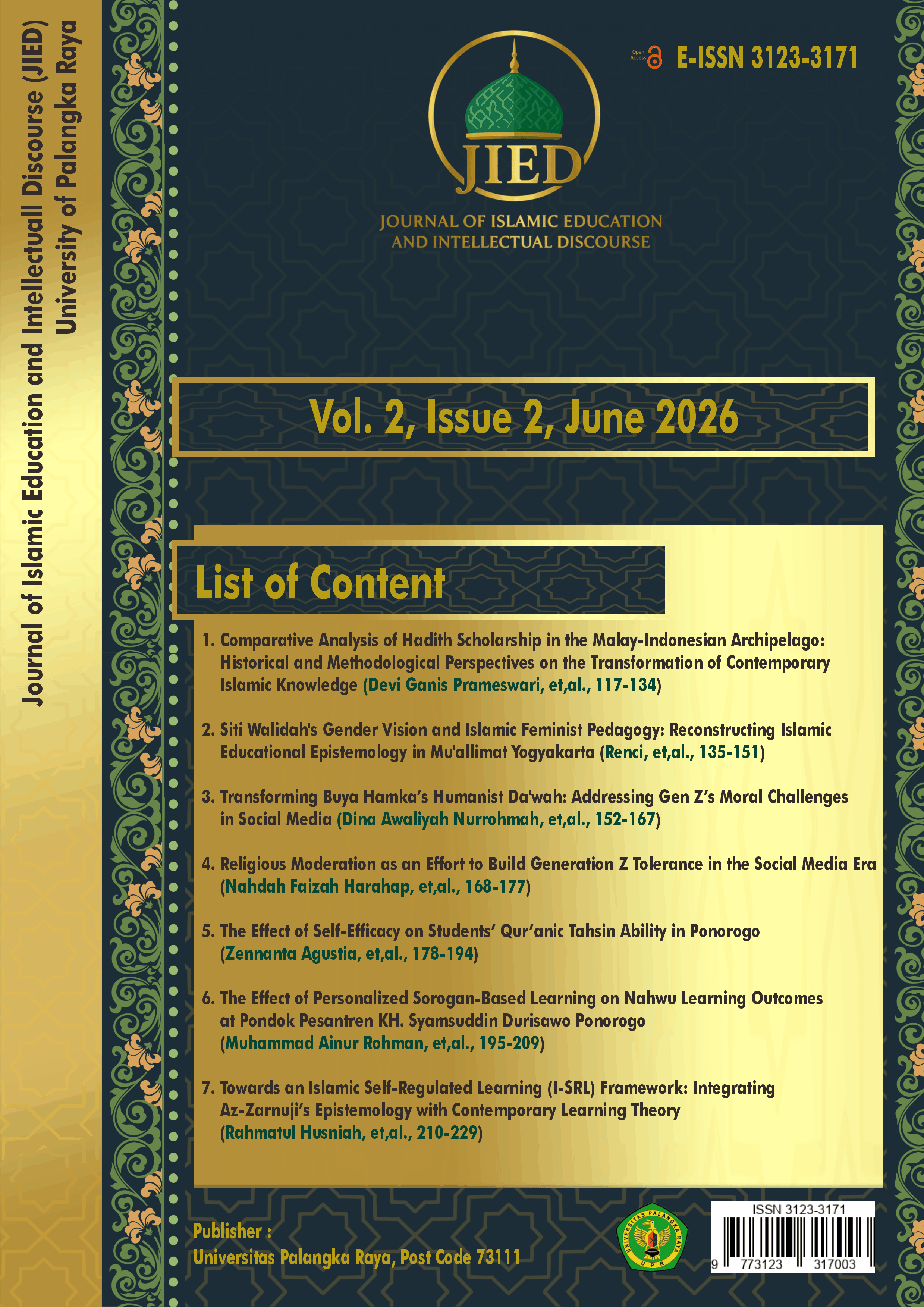
Comparative Analysis of Hadith Scholarship in the Malay-Indonesian Archipelago: Historical and Methodological Perspectives on the Transformation of Contemporary Islamic Knowledge
(Analisis Komparatif Studi Hadis di Nusantara: Telaah Historis-Metodologis dalam Konteks Transformasi Keilmuan Islam Kontemporer)
DOI:
https://doi.org/10.37304/jied.v2i02.25225Keywords:
Hadith Studies; Hadith Epistemology; Comparative Scholarship; Riwayah-Dirayah Integration; Digital Hadith ScholarshipAbstract
This study provides a comparative analysis of the development of hadith studies in the Nusantara region, focusing on Indonesia and Malaysia within the context of contemporary Islamic scholarly transformation. The scope of the analysis includes scholarly networks and the transmission of knowledge from the Haramayn, methodological differences between the turath-based approach in Nusantara and the academic systematic approach in Malaysia, as well as the role of educational institutions in integrating the tradition of sanad with digital innovation. Employing a qualitative historical comparative method, the data are derived from curricula, the works of local muhaddithun, and relevant academic literature. The findings indicate that hadith studies in Indonesia are characterized by a sanad-centric orientation through systems of talaqqi and ijazah, whereas in Malaysia they tend to be more analytical and academically structured. Both contexts currently face challenges related to integration with digital technologies, including the use of AI, online databases, and the digitization of kitab kuning. These epistemological differences are not dichotomous but instead reflect methodological diversity that enriches Islamic studies in Southeast Asia. This study underscores the importance of synergy between the approaches of riwayah (transmission) and dirayah (rational analysis) as a foundation for developing integrated curricula in pesantren, universities, and research institutions. Academically, this research offers a new conceptual framework for integrating classical tradition and digital technology in hadith studies.
Downloads
References
Abdul Mustaqim. (2016). Metode Penelitian Living Quran dan Hadis. Jurnal Walisongo.
Abdullah. (2019). The Development of Hadith Studies in Malaysia. Journal of Islamic Studies Malaysia, 112–115.
Ahmad, K. A. (2018). Pengajaran dan Pembelajaran Ilmu Hadis di Institusi Pendidikan Tinggi Malaysia. Jurnal Al-Bayan, 15, 72–74.
Azami, M. M. (2002). Studies in Hadith Methodology and Literature.
Azra. (2004). The Origins of Islamic Reformism in Southeast Asia. Honolulu: University of Hawai‘i Press, 55–57.
Azra, A. (2013). Jaringan Ulama Timur Tengah dan Kepulauan Nusantara Abad XVII dan XVIII. Kencana.
Basri, H. (2018). Integrasi Fiqh dan Hadis dalam Pendidikan Pesantren. Jurnal Agama, 45–48.
Bowen, G. A. (2009). Document Analysis as a Qualitative Research Method. Qualitative Research Journal, 29–31.
Bruinessen, M. (1995). Kitab Kuning, Pesantren dan Tarekat: Tradisi Islam di Indonesia.
Creswell, J. W. (2018). Qualitative Inquiry and Research Design: Choosing Among Five Approaches. . 74–77.
Fuadi, A. I. (2025). Reassessing Classical Kalam: A Critical Analysis of the Relevance of Islamic Theology in the Age of Globalization. Journal Of Islamic Education And Intellectual Discourse (JIED), 1(1), 44–58. https://doi.org/10.37304/jied.v1i1.23399
Halim, N. A. (2020). Pendekatan Integratif dalam Pengajaran Bahasa Arab dan Studi Hadis di Universiti Sains Islam Malaysia,. Al-Furqan Journal of Quranic Studies, 14(2), 88–90.
Huda, A. A. S., Aghnia, A., Nurhuda, A., Hamdi, H., Ahmad, W. I., Anugerah, D. S., & Sutrianti, S. (2025). Strengthening Social Piety Values through Academic Studies with Bibliometric Analysis of Research Publications 2015-2025. Journal Of Islamic Education And Intellectual Discourse (JIED), 1(2), 143–163. https://doi.org/10.37304/jied.v1i2.23488
Karim, K. N. M. (2021). Institusionalisasi Pengajian Hadis di Malaysia. Jurnal Usuluddin, 49, 45–49.
Mahfudz al-Tarmasi. (1900). Manhaj Dzawi al-Nazhar Mekkah Maktabah al-Haramayn.
Mahmud at-Tahhan. (1995). Taysir Mustalah al Hadis.
Mustafa, I., & Gazali. (2025). The Epistemology of Hadith in Muhammadiyah: From As-Sunnah As-Sahihah to As-Sunnah Al-Maqbulah. Journal of Islamic Education and Intellectual Discourse (JIED), 1(2), 236–249. https://doi.org/10.37304/jied.v1i2.23704
Norshariani Abd Rahman Fauzi, Mohd Yusuf, Z. H. (2021). Sumbangan Dato’Dr Abdul Hayei Bin Abdul Sukor dalam Bidang Hadith di Malaysia. Journal of Hadith Studies, 6(1), 45–58.
Rahman, F. (2020). Transformasi Kurikulum Studi Hadis di Perguruan Tinggi Islam Indonesia. Jurnal Usuluddin, 28(2), 198–192.
Rosmawati Hashim. (2020). Metodologi Kajian Hadis di Malaysia: Antara Tradisi dan Pembaharuan. Jurnal Usuluddin, 50, 98–100.
Suherman, A., & Rohman, M. (2021). Dinamika Kajian Hadis di Indonesia: Dari Pesantren ke Perguruan Tinggi. Jurnal Penelitian Dan Pengembangan Keilmuan Islam, 10, 204–206.
Suryadilaga, M. A. (2022). Studi Hadis di Asia Tenggara: Genealogi, Transformasi, dan Tantangan. Jurnal Imu Hadis Nusantara, 3(2), 145–147.
Yusoff, N. (2020). The Institutionalization of Hadith Studies in Malaysia. Kuala Lumpur. IIUM Press, 77–84.
Downloads
Published
How to Cite
Issue
Section
License
Copyright (c) 2026 Devi Ganis Prameswari, Cermi City Mulyanti, Dadah Sa’adah

This work is licensed under a Creative Commons Attribution-ShareAlike 4.0 International License.
The author retains full copyright over his/her work. The article is licensed under: Creative Commons Attribution-ShareAlike 4.0 International (CC BY-SA 4.0). This license permits others to copy, distribute, display, and create derivative works, provided they acknowledge the author(s) and the source of the original publication.